Find branch current IR2.
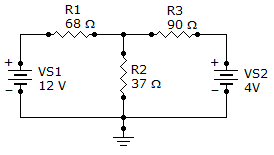
Select an option to see the answer and solution.
The branch current method uses.
Select an option to see the answer and solution.
In assigning the direction of branch currents.
Select an option to see the answer and solution.
The first row of a certain determinant has the numbers 3 and 5. The second row has the numbers 7 and 2. The value of this determinant is
Select an option to see the answer and solution.
What is the voltage drop across R1?
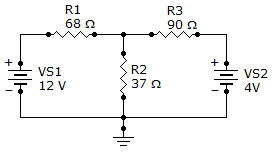
Select an option to see the answer and solution.
The mesh method can be applied to circuits with any number of loops.
Select an option to see the answer and solution.
A loop current is an actual current in a branch.
Select an option to see the answer and solution.
What is the current through R2?
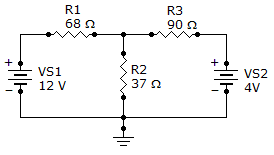
Select an option to see the answer and solution.
Second-order determinants are evaluated by subtracting the signed cross-products.
Select an option to see the answer and solution.
Find the node voltage VA.
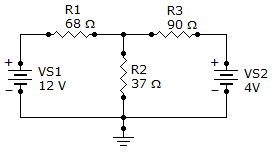
Select an option to see the answer and solution.
The branch current method is based on Kirchhoff's voltage law and Kirchhoff's current law.
Select an option to see the answer and solution.
The mesh current method is based on Kirchhoff's current law.
Select an option to see the answer and solution.
The node voltage method is based on Kirchhoff's voltage law.
Select an option to see the answer and solution.
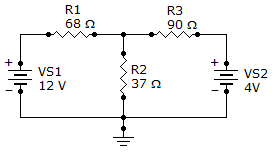
Using the mesh current method, find the branch current, IR1, in the above figure.
Select an option to see the answer and solution.
When assigning branch currents, you need not be concerned with the direction you choose.
Select an option to see the answer and solution.
Generally, the mesh current method results in fewer equations than the node voltage method.
Select an option to see the answer and solution.
Third-order determinants are evaluated by the expansion method or by the cofactor method.
Select an option to see the answer and solution.
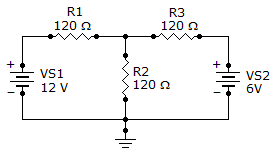
Find the node voltage VA.
Select an option to see the answer and solution.
The expansion method for evaluating determinants is
Select an option to see the answer and solution.
