A sphere and a cylinder having the same mass and radii start from rest and roll down the same inclined plane. Which body gets to the bottom first?
A. Sphere with greater rotational energy at bottom than cylinder
B. Sphere with lesser rotational energy at bottom than cylinder
C. Cylinder with greater rotational energy at bottom than sphere
D. Both reach the bottom simultaneously with equal rotational energy at bottom
Select an option to see the answer and solution.
A light rope is loaded with many equal weights at equal horizontal intervals. The points of suspension on the rope lie on a
A. Parabola
B. Catenary
C. Cycloid
D. Ellipse
Select an option to see the answer and solution.
If the resultant of two forces has the same magnitude as either of the force, then the angle between the two forces is
Select an option to see the answer and solution.
If the resultant of two forces P and Q acting at an angle θ α α
A. P − Q cos θ P sin θ
B. P + Q cos θ Q sin θ
C. P + Q tan θ P sin θ
D. P + Q sin θ Q sin θ
Select an option to see the answer and solution.
The motion of a particle moving with S.H.M. from an extremity to the other, constitutes
A. Half an oscillation
B. One full oscillation
C. Two oscillations
D. None of these
Select an option to see the answer and solution.
The unit of Moment of Inertia of a body, is
Select an option to see the answer and solution.
The angle of projection at which the horizontal range and maximum height of a projectile are equal to
Select an option to see the answer and solution.
The angle of projection at which the horizontal range and maximum height of a projectile are equal to
A. 45
B. θ = tan − 1 ( 0.25 )
C. θ = tan − 1 4 or θ = 70
D. 60
Select an option to see the answer and solution.
A rigid body is in a stable equilibrium if the application of any force
A. Can raise the CG of the body but cannot lower it
B. Tends to lower the CG of the body
C. Neither raises nor lowers the CG of the body
D. None of above
Select an option to see the answer and solution.
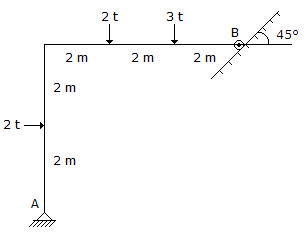
What is the answer to this question?
A. 10.8 t
B. 10.6 t
C. 10.4 t
D. 10.2 t
Select an option to see the answer and solution.
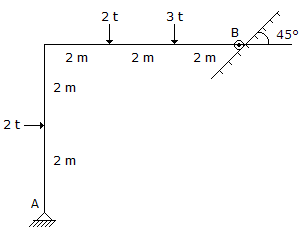
What is the answer to this question?
Select an option to see the answer and solution.
Which of the following represents the state of neutral equilibrium?
A. A cube resting on one edge
B. A smooth cylinder lying on a curved surface
C. A smooth cylinder lying on a convex surface
D. None of the above
Select an option to see the answer and solution.
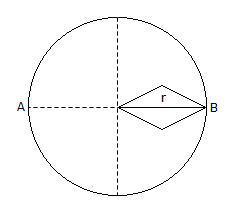
A square hole is made in a circular lamina, the diagonal of the square is equal to the radius of the circle as shown in below figure the shift in the centre of gravity is
A. ( π − 0.5 ) r ( π − 0.75 )
B. ( π − 0.75 ) r ( π − 0.25 )
C. ( π − 0.75 ) r ( π − 0.5 )
D. ( π − 0.25 ) r ( π − 0.5 )
Select an option to see the answer and solution.
The potential energy of a particle falling through a straight shaft drilled through the earth (assumed homogenous and spherical) is proportional to (where r is the distance of’the particle from centre of the earth)
Select an option to see the answer and solution.
A stone is whirled in a vertical circle, the tension in the string, is maximum
A. When the string is horizontal
B. When the stone is at the highest position
C. When the stone is at the lowest position
D. At all the positions
Select an option to see the answer and solution.
The graphical method of determining the forces in the members of a truss is based on
A. Method of joint
B. Method of section
C. Either method
D. None of the two methods
Select an option to see the answer and solution.
The shape of a suspended cable under its own weight, is
A. Parabolic
B. Circular
C. Catenary
D. Elliptical
Select an option to see the answer and solution.
The maximum value of the horizontal range for a projectile projected with a velocity of 98 m/sec is
A. 98 m
B. 490 m
C. 980 m
D. 1960 m
Select an option to see the answer and solution.
A geo-stationary satellite is one which orbits the earth with a velocity of rotation of
Select an option to see the answer and solution.
A particle moving with a simple harmonic motion, attains its maximum velocity when it passes
A. The extreme point of the oscillation
B. Through the mean position
C. Through a point at half amplitude
D. None of these
Select an option to see the answer and solution.