A force with which the plates of a parallel plate capacitor having charge Q and area of each plate A, attract each other is:
1. directly proportional to Q
2. directly proportional to Q2
3. inversely proportional to A
Of these statements which are correct?
A plane wave of wavelength λ is travelling in a direction making an angle 30° with positive x-axis and 90° with positive y-axis. The E field of the plane wave can be represented as (E0 is a constant)
A boundary separates two magnetic materials of permeability µ1 and µ2. The magnetic field vector in µ1 is H1 with a normal component Hn1 and tangential component Ht1 while that in µ2 is H2 with normal component Hn2 and a tangential component Ht2. Then the derived conditions would be
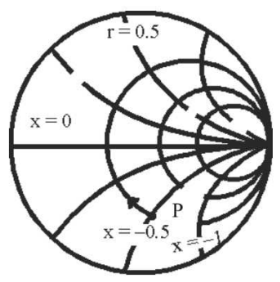
Consider an impedance Z = R + jX marked with point P in an impedance Smith chart as shown in figure. The movement from point P along a constant resistance circle in the clockwise direction by an angle 45° is equivalent to-
An electromagnetic wave having frequency f0 gets attenuated by a factor of e-2 after propagating a distance d in a good conductor. If the signal frequency is now reduced to 0.5 f0, after travelling the same distance d in the same conductor, the signal will get attenuated by a factor of:
If a lossless line is terminated with a load impedance 40 + j30 Ω, then the characteristic impedance of the line for minimum possible standing wave ratio (SWR) will be
Two metal rings 1 and 2 are placed in a uniform magnetic field which is decreasing with time their planes perpendicular to the field. If the rings are identical except that ring 2 has a thin air gap in it, which one of the following statement is correct?
If over the course of a day, the maximum electron density in the ionosphere varies from 1011 to 1012 m-3; the critical frequency changes approximately from:
A plane wave having x-directed electric field propagating in free space along the z-direction is incident on an infinite electrically conducting (perfect conductor) sheet at z = 0 plane. Which one of the following is correct?
The capacitance per unit length and the characteristic impedance of a lossless transmission line are C and Z0 respectively. The velocity of a travelling wave on the transmission line is
An elliptically polarized wave travelling in the positive Z-direction in air has x and y components
Ex = 3sin(ωt - βz) V/m
Ey = 6sin(ωt - βz + 75°) V/m