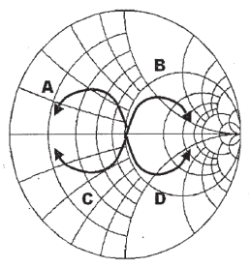
A transmission line of characteristic impedance 75 ohms is terminated with an impedance of 50 ohms. The line length is increased from zero. What will be the locus of the input impedance at the other end of the line? (N.B. : Reference impedance of Smith Chart = 50 Ohms)
A conductor of length 1 m moves at right angles to a uniform magnetic field of flux density 2 Wb/m2 with a velocity of 50 m/s. What is the value of the induced e.m.f. when the conductor moves at an angle of 30° to the direction of the field?
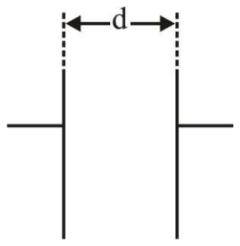
The parallel-plate capacitor shown in the figure has movable plates. The capacitor is charged so that the energy stored in it is E when the plate separation is d. The capacitor is then isolated electrically and the plates are moved such that the plate separation becomes 2d.
At this new plate separation what is the energy stored in the capacitor, neglecting fringing effects?
The solutions to many problems involving electric fields are simplified by making use of equipotential surfaces. An equipotential surface is a surface:
1. On which the potential is same everywhere
2. The movement of charge over such a surface would require no work
3. The tangential electric field is zero
4. The normal electric field is zero
Which of the above statements are correct?
Two identical coaxial coils carry the same current I but in opposite directions. The magnitude of the magnetic field B at a point on the axis midway between the coils is
Consider a transmission line of characteristic impedance 50 ohms and the line is terminated at one end by +j50 ohms, the VSWR produced in the transmission line will be
The conducting thin coils X and Y (identical except for a thin cut in coil Y) are placed in a uniform magnetic field which is decreasing at a constant rate. If the plane of the coils is perpendicular to the field lines, which of the following statement is correct? As a result, emf is induced in:
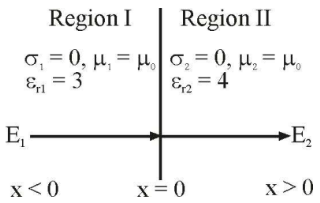
A medium is divided into regions I and II about x = 0 plane, as shown in the figure below. An electromagnetic wave with electric field E1=4a^x+3a^y+5a^z is incident normally on the interface from region-I. The electric field E2 in region-II at the interface is