The power of a three phase, three wire balanced system was measured by two Wattmeter method. The reading of one Wattmeter was found to be doubled that of other. What is the power factor of the system?
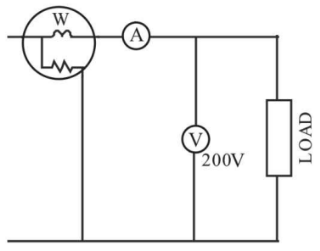
Consider the following data for the circuit shown above:
Ammeter : Resistance 0.2 Ω; Reading 5.0 A
Voltmeter: Resistance 2 kΩ ; Reading 200 V
Wattmeter : Current coil resistance 0.2 Ω
Pressure coil resistance 2 KΩ
Load : Power factor = 1
The reading of the Wattmeter is:
A 100 Ω resistive potentiometer is used with an input supply voltage of 10 V. If the thermal resistance 30°C/W and the ambient temperature is 40°C, the temperature of the POT is
A wire strain gauge element subjected to a strain has a gauge factor of 2, a resistance of 125 ohms and is of 1 m length. For a change in length of the wire by 0.005 m, the change in the resistance will be
A 300 V, 5 A, 0.2 pf low power factor wattmeter is used to measure the power consumed by a load. The wattmeter scale has 150 divisions and the pointer is on the 100th division. The power consumed by the load (in watts) is:
Some of the functional building blocks of a measurement system are:
Primary Sensing element (PSE)
Variable conversion Element (VCE) or Transducer
Data Transmission element (DTE)
Variable manipulation Element (VME)
Data Presentation Element (DPE)
The correct sequential connection of a the functional building blocks for an electronic pressure gauge will be:
Consider the following statements regarding sources of error in a Q-meter:
1. If a coil with resistance R is connected in direct measurement mode and if the residual resistance of Q-meter is 0.1 R, then the measured Q of the coil would be 1.1 times the actual Q.
2. If the inductance to be measured is less than 0.1 mH, the error due to presence of residual inductance cannot be neglected.
3. The presence of distributed capacitance in a coil modifies the effective Q of the coil.
Which of the above statements are correct?