A periodic signal x(t) has a trigonometric Fourier series expansion x ( t ) = a 0 + n = 1 ∑ ∞ ( a n cos n ω 0 t + b n sin n ω 0 t ) x ( t ) = − x ( − t ) = − x ( t − ω 0 π ) ,
A. an are zero for all n and bn are zero for n even
B. an are zero for all n and bn are zero for n odd
C. an are zero for n even and bn are zero for n odd
D. an are zero for n odd and bn are zero for n even
Select an option to see the answer and solution.
The transfer function of a linear system is the
A. ratio of the output, v0 (t), and input, vi (t)
B. ratio of the derivatives of the output and the input
C. ratio of the Laplace transform of the output and that of the input with all initial conditions zeros
D. none of these
Select an option to see the answer and solution.
Match
List-I with
List-II and select the correct answer using the options given below:
List-I (Function)List-II (Fourier Transforms)
a. exp ( − α t ) u ( t ) , α > 0
1. ( α + j 2 π f ) 2 1
b. exp ( − α ∣ t ∣ ) , α > 0
2. α + j 2 π f 1
c. texp ( − α t ) u ( t ) , α > 0
3. δ ( f − t 0 α )
d. exp ( j 2 π α t / t 0 )
4. α 2 + ( 2 π f ) 2 2 α
A. a-3, b-1, c-4, d-2
B. a-2, b-4, c-1, d-3
C. a-3, b-4, c-1, d-2
D. a-2, b-1, c-4, d-3
Select an option to see the answer and solution.
The Fourier Transform of a function x(t) is X(f). The Fourier transform of d t d x ( t )
A. d t d X ( f )
B. j 2 π f X ( f )
C. j f X ( f )
D. j f X ( f )
Select an option to see the answer and solution.
A finite duration discrete-time signal x(n) is obtained by sampling the continuous-time signal x(t) = cos(200πt) at sampling instant t = n/400, n = 0, 1, . . . , 7. The 8-point discrete Fourier transform (DFT) of x(n) is defined as X [ k ] = n = 0 ∑ 7 x [ n ] e 4 − j π k n , k = 0 , 1 , ..... , 7
A. Only X(2) and X(6) are non-zero
B. Only X(3) and X(5) are non-zero
C. All X(k) are non-zero
D. Only X(4) is non-zero
Select an option to see the answer and solution.
In inverse DTFT, the . . . . . . . . is defined between -π to π because of the property.
A. Time Invariance
B. Periodicity
C. Multiplication
D. Implication
Select an option to see the answer and solution.
If random process X(t) and Y(t) are orthogonal then
A. Sxy (f) = 0
B. Sxy (f) = Sx (f) = Sy (f)
C. Rxy (τ) = h(τ)
D. H(f) = 0
Select an option to see the answer and solution.
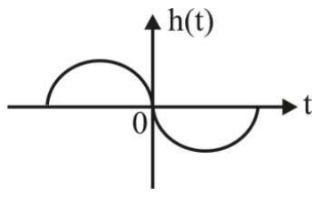
Consider a system whose input x and output y are related by the equation
y ( t ) = − ∞ ∫ ∞ x ( t − τ ) h ( 2 τ ) d τ
where h(t) is shown in the graph
Which of the following four properties are possessed by the system?
BIBO: Bounded input gives a bounded output
Causal : The system is causal
LP : The system is low pass
LTI : The system is linear and time-invariant
A. Causal, LP
B. BIBO, LTI
C. BIBO, Causal, LTI
D. LP, LTI
Select an option to see the answer and solution.
Which of the following is the correct statement?-n is
A. absolutely integrable
B. absolutely summable
C. unity
D. < 1
Select an option to see the answer and solution.
About the Fourier series expansion of a periodic function it can be said that
A. Even functions have only a constant and cosine terms in their FS expansion
B. Odd functions have only sine terms in their FS expansion
C. Functions with half wave symmetry contain only odd harmonics
D. All the above three
Select an option to see the answer and solution.
A system which has a unique relationship between its input and output is called
A. Linear system
B. Causal system
C. Time invariant system
D. Invertible system
Select an option to see the answer and solution.
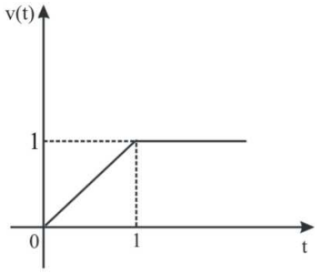
Laplace transform of the function v(t) shown in the figure is:
A. s2 [1 - es ]
B. s2 [1 - e-s ]
C. s 2 1 s ]
D. s 2 1 -s ]
Select an option to see the answer and solution.
Let x(t) be the input and y(t) be the output of a continuous time system. Match the system properties P1 , P2 and P3 with system relations R1 , R2 , R3 , R4 Properties 1 : Linear but NOT time-invariant2 : Time-invariant but NOT linear3 : Linear and time-invariantRelations 1 : y(t) = t2 x(t)2 : y(t)= t|x(t)|3 : y(t) = |x(t)|4 : y(t) = x(t - 5)
A. (P1 , R1 ), (P2 , R3 ), (P3 , R4 )
B. (P1 , R2 ), (P2 , R3 ), (P3 , R4 )
C. (P1 , R3 ), (P2 , R1 ), (P3 , R2 )
D. (P1 , R1 ), (P2 , R2 ), (P3 , R3 )
Select an option to see the answer and solution.
A system whose impulse response is zero outside of some finite interval is termed as
A. FIR
B. IIR
C. either FIR or IIR
D. none of the above
Select an option to see the answer and solution.
For separating channels in FDM receivers
A. Band pass filters are used
B. Band stop filters are used
C. Differentiators are used
D. Integrators are used
Select an option to see the answer and solution.
The probability cumulative distribution function must be monotone and
A. increasing
B. decreasing
C. non-increasing
D. non-decreasing
Select an option to see the answer and solution.
Given that x1 (t) = ek1 t u(t) and x2 (t) = e-k2 t u(t). Which one of the following gives their convolution?
A. [ k 1 + k 2 ] [ e k 1 t − e − k 2 t ]
B. [ k 2 − k 1 ] [ e k 1 t − e − k 2 t ]
C. [ k 2 + k 1 ] [ e k 1 t + e − k 2 t ]
D. [ k 2 − k 1 ] [ e k 1 t + e − k 2 t ]
Select an option to see the answer and solution.
What is the magnitude square function of a normalized Butterworth filter to 1 rad/sec cut-off frequency as
A. 1 + ( Ω ) 2 N 1
B. 1 + ( Ω C Ω ) 2 N 1
C. D. Select an option to see the answer and solution.
If F(s) and G(s) are the Laplace transform of f(t) and g(t), then their product F(s).G(s) = H(s), where H(s) is the Laplace transform of h(t), is defined as
A. (f.g)(t)
B. ∫ 0 t f ( τ ) g ( t − τ ) d τ
C. Both A and B are correct
D. f(t).g(t)
Select an option to see the answer and solution.
Which one of the following statements is correct for the given system?y ( n ) = x 2 ( n ) + x 2 ( n − 1 ) 1
A. The given system is linear, non-causal and shift-variant
B. The given system is non-linear, causal and shift-invariant
C. The given system is non-linear, causal and shift-variant
D. The given system is linear, non-causal and shift-invariant
Select an option to see the answer and solution.