If x1 (t) = 2sinπt + cos4πt and x2 (t) = 2sin5πt + 3sin13πt, then
A. x1 and x2 both are periodic
B. x1 and x2 both are not periodic
C. x1 is periodic, but x2 is not periodic
D. x1 is not periodic, but x2 is periodic
Select an option to see the answer and solution.
A data sequence x[n] = {1, 2, 3, 4, 5} passes through a linear time-invariant system with impulse response h[n] = {5, 4, 3, 2, 1}. The output of the filter will be
A. {6, 6, 6, 6, 6}
B. {5, 8, 9, 8, 5}
C. {5, 14, 26, 40, 55, 40, 26, 14, 5}
D. {1, 4, 10, 20, 35, 44, 46, 40, 25}
Select an option to see the answer and solution.
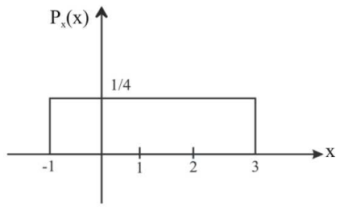
For a random variable 'x' having the probability density function (PDF) as shown in the above figure, what are the values of the mean and the variance, respectively?
A. 2 1 3 2
B. 1 and 3 4
C. 1 and 3 2
D. 2 and 3 4
Select an option to see the answer and solution.
If the impulse response of a discrete-time system is h[n] = -5n u[-n - 1], then the system function H(z) is equal to
A. z − 5 − z
B. z − 5 z
C. z − 5 − z
D. z − 5 z
Select an option to see the answer and solution.
For distortion less transmission through LTI system phase of H(ω) is
A. Constant
B. One
C. Zero
D. Linearly dependent on ω
Select an option to see the answer and solution.
The autocorrelation of wide-sense random process is given by e-2|τ| . The peak value of the spectral density is
Select an option to see the answer and solution.
If the cumulative distribution function is Fx (x) then the probability density function fx (x) is given as
A. ∫ F x ( x ) d x
B. ∫ d x d F x ( x )
C. ∫ F x ( − x ) d x
D. d x d F x ( − x )
Select an option to see the answer and solution.
The fundamental period T of a periodic-continuous time signal x(t), is
A. the smallest positive constant satisfying the relation x(t) = x(t + mT) for every t and any integer m
B. the positive constant satisfying the relation x(t) = x(t + mT) for every t and any integer m
C. the largest positive constant satisfying the relation x(t) = x(t + mT) for any t and any integer m
D. the smallest positive integer satisfying the relation x(t) = x(t + mT) for any t and any m
Select an option to see the answer and solution.
The periodic signal x(t) = 5cos(ω0 t + 30°), signal is periodic with fundamental period . . . . . . . .
A. ω 0 2 π
B. ω 0 π
C. 2 π
D. 2 π ω 0
Select an option to see the answer and solution.
Match
List-I with
List-II and select the correct answer using the options given below:
List-I (Functions in the time domain)List-II (Fourier transform of the function)
a. Delta function
1. Delta function
b. Gate function
2. Gaussian function
c. Normalized Gaussian
3. Constant function
d. Sinusoidal function
4. Sampling Function
A. a-1, b-2, c-4, d-3
B. a-3, b-4, c-2, d-1
C. a-1, b-4, c-2, d-3
D. a-3, b-2, c-4, d-1
Select an option to see the answer and solution.
The signal cos ( 10 π t + 4 π ) ( π t sin ( π t ) ) cos ( 40 π t − 2 π ) .
A. 2 15 cos ( 40 π t − 4 π )
B. 2 15 ( π t sin ( π t ) ) cos ( 10 π t + 4 π )
C. 2 15 cos ( 10 π t − 4 π )
D. 2 15 ( π t sin ( π t ) ) cos ( 10 π t − 4 π )
Select an option to see the answer and solution.
Let {x_1}\left( t \right) = \left\{ {\begin{array}{*{20}{c}}
6&{{\text{for }}0 < t < 4} \\
0&{{\text{otherwise}}}
\end{array}} \right.{\text{and }}{x_2}\left( t \right) = u\left( {t - 2} \right) and y(t) = x1 (t) * x2 (t), then the value of y(4) is
Select an option to see the answer and solution.
The impulse response of a causal, linear, time-invariant, continuous-time system is h(t). The output y(t) of the same system to an input x(t), where x(t) = 0 for t < -2, is
A. 0 ∫ t h ( τ ) x ( t − τ ) d τ
B. − 2 ∫ t h ( τ ) x ( t − τ ) d τ
C. − 2 ∫ t − 2 h ( τ ) x ( t − τ ) d τ
D. 0 ∫ t + 2 h ( τ ) x ( t − τ ) d τ
Select an option to see the answer and solution.
Given that h(t) = 10e-10 u(t), and e(t) = sin10t.u(t), the Laplace transform of the signal f ( t ) = τ = 0 ∫ t h ( t − τ ) e ( τ ) d τ
A. ( s + 10 ) ( s 2 + 100 ) 10
B. ( s 2 + 100 ) 10 ( s + 10 )
C. ( s + 10 ) ( s 2 + 100 ) 100
D. ( s + 10 ) ( s 2 + 100 ) 1
Select an option to see the answer and solution.
Consider a 51 tap linear phase FIR filter operating at a sampling frequency of 10 kHz. The delay of this linear phase FIR is:
A. 2.55 milliseconds
B. 5 milliseconds
C. 5.1 milliseconds
D. 2.5 milliseconds
Select an option to see the answer and solution.
A digital filter has transfer function H ( z ) = z 2 + 0.81 z 2 + 1 .
A. 50 Hz
B. 100 Hz
C. 150 Hz
D. 200 Hz
Select an option to see the answer and solution.
A linear time invariant system has an impulse response e2t , for t > 0. If initial conditions are zero and the input is e3t , the output for t > 0 is
A. e3t - e2t
B. e5t
C. e3t + e2t
D. None of these
Select an option to see the answer and solution.
The z-transform of the discrete time signal x(n) = u(n)*u(n) with '*' being convolution is
A. [ 1 − z − 1 ] 2 1 , ROC : ∣ z ∣ < 1
B. [ 1 − z − 1 ] 2 1 , ROC : ∣ z ∣ > 1
C. [ 1 − z ] 2 1 , ROC : ∣ z ∣ > 1
D. [ 1 − z ] 2 1 , ROC : ∣ z ∣ < 1
Select an option to see the answer and solution.
If a linear time invariant system is excited by a true random single like white noise, the output of the linear system will have which of the following properties?
A. Output will be a white noise
B. Output will be periodic
C. Output will not be random
D. Output will be correlated or coloured noise
Select an option to see the answer and solution.
Given the 'Energy Spectrum Density, Sxx (f) of a sequence x(n)
A. We cannot getback x(n) uniquely
B. We can getback x(n) uniquely
C. We can not get back the auto-correlation sequence uniquely
D. We can get back x(ej∞ ) uniquely
Select an option to see the answer and solution.