The decreasing order of nucleophilicity for the following anions is
CH3 CO 2 − 3 O- , C6 H5 O- , NO 3 −
A. CH3 CO 2 − 3 O- > C6 H5 O- > NO 3 −
B. CH3 O- > NO 3 − 6 H5 O- > CH3 CO 2 −
C. CH3 O- > C6 H5 O- > CH3 CO 2 − O 3 −
D. C6 H5 O- > CH3 O- > NO 3 − 3 CO 2 −
Select an option to see the answer and solution.
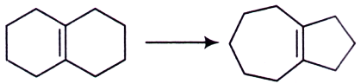
The most appropriate sequence of the reactions for carrying out the following conversion
is
A. (i) peracid, (ii) H+ , (iii) Zn/dil.HCl
B. (i) Alkaline KMnO4 , (ii) NalO4 , (iii) N2 H4 /KOH
C. (i) Alkaline KMnO4 , (ii) H+ , (iii) Zn/dil.HCl
D. (i) O3 /Me2 S, (ii) NaOEt, (iii) N2 H4 /KOH
Select an option to see the answer and solution.
Which of the following compounds is expected to show a sharp singlet for one of its protons at δ ≥ 8 ppm in 1 H NMR spectrum, given that this signal remains unaffected on shaking the solution thoroughly with D2 O?
A. CH3 CO2 H
B. CH3 CONHC6 H5
C. n-C6 H13 C ≡ CH
D. n-C6 H13 CHO
Select an option to see the answer and solution.
Conversion of Ph-NH2 into Ph-CN can be accomplished by
A. reaction with sodium cyanide in the presence of nickel catalyst
B. reaction with chloroform and sodium hydroxide
C. diazotisation followed by reaction with CuCN
D. reaction with ethyl formate followed by thermolysis
Select an option to see the answer and solution.
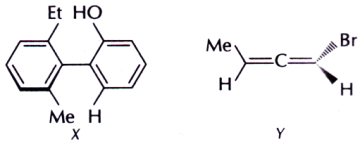
The absolute configuration for compounds X and Y respectively are
Select an option to see the answer and solution.
The reactive intermediate involved in the conversion of phenol to salicylaldehyde using chloroform and sodium hydroxide is
A. Cl2 C:
B. Cl2 CH+
C. Cl2 CH-
D. Cl2 C+
Select an option to see the answer and solution.
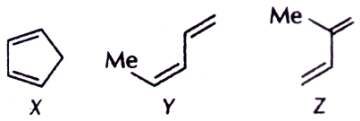
Order of reactivity of the following dienes X, Y and Z in Diels-Alder reaction is
A. X > Z > Y
B. Y > X > Z
C. Y > Z > X
D. X > Y > Z
Select an option to see the answer and solution.
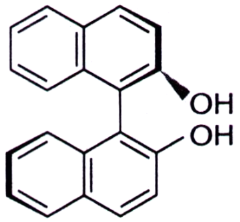
The binaphthol (Bnp) is
A. an optically active compound with (R)-configuration
B. an optically inactive compound
C. a meso compound
D. an optically active compound with (S)-configuration
Select an option to see the answer and solution.
Aniline can be distinguished from methyl amine by its reaction with
A. p-toluene sulphonyl chloride/KOH
B. (i) NaNO2 /HCl, 0-5°C (ii) alkaline β naphthol
C. Sn/HCl
D. Acetyl chloride
Select an option to see the answer and solution.
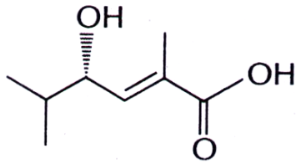
For the compound,
the stereochemical notations are
A. 2Z, 4R
B. 2Z, 4S
C. 2E, 4R
D. 2E, 4S
Select an option to see the answer and solution.
1 H NMR spectrum of [18]-annulene shows
A. only one peak at δ 7.2 (18H)
B. only one peak at δ 5.0 (18H)
C. two peaks at δ 9.0 (12H) and δ - 3.0 (6H)
D. two peaks at δ 9.0 (6H) and δ - 3.0 (12H)
Select an option to see the answer and solution.
Oxymercuration-demercuration reaction of t-methylcyclohexene gives
A. cis-2-methylcyclohexanol
B. trans-2-methylcyclohexanol
C. 1-methylcyclohexanol
D. mixture of cis and trans-2-methylcyclohexano
Select an option to see the answer and solution.
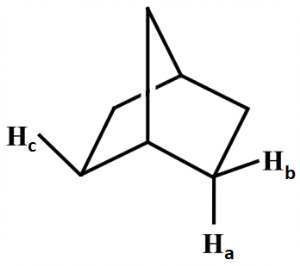
Identify the correct stereochemical relationship amongst the hydrogen atoms H
a , H
b and H
c in the following molecule
A. Ha and Hb : enantiotopic
B. Ha and Hb : diastereotopic
C. Ha and Hc : enantiotopic
D. Ha and Hc : diastereotopic
Select an option to see the answer and solution.
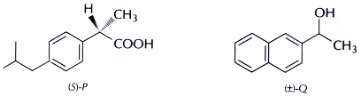
Esterification of the acid P with the alcohol Q will give
A. only one enantiomer
B. a mixture of diastereomers
C. a mixture of enantiomers
D. only one diastereomer
Select an option to see the answer and solution.
Proteins are biopolymers. The monomer units present in them are
A. carbohydrates
B. amino acids
C. fatty acids
D. alkenes
Select an option to see the answer and solution.
The acylanion equivalents among the following compounds (P-S) are
A. P and Q
B. Q and R
C. P and S
D. Q and S
Select an option to see the answer and solution.
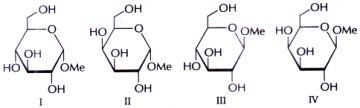
Identify the correct set of stereochemical relationships amongst the following monosaccharides I-IV
A. I and II are anomers; III and IV are epimers
B. I and III are epimers; II and IV are anomers
C. I and II are epimers; III and IV are anomers
D. I and III are anomers; I and II are epimers
Select an option to see the answer and solution.
(E)-3-bromo-3-hexene when treated with CH3 O- in CH3 OH gives
A. 3-hexyne
B. 2-hexyne
C. 2, 3-hexadiene
D. 2, 4-hexadiene
Select an option to see the answer and solution.
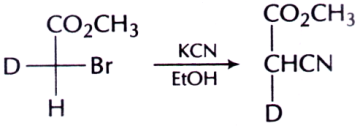
The configurations of the reactant and the product in the following reaction, are
Select an option to see the answer and solution.
The absolute configurations of two chiral centres in the following molecule are
A. 2(R), 3(S)
B. 2(R), 3(R)
C. 2(S), 3(S)
D. 2(S), 3(R)
Select an option to see the answer and solution.