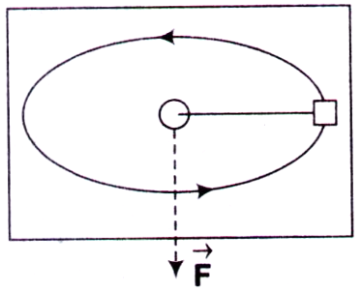
A mass m is constrained to move on a horizontal frictionless surface. It is set in circular motion with radius r0 and angular speed ω0 by an applied force F communicated through an inextensible thread that passesthrough a hole on the surface as shown in figure given below. Then, this force is suddenly doubled.
The magnitude of the radial velocity of the mass
Two solid spheres of radius R and mass M each are connected by a thin rigid rod of negligible mass. The distance between the centre is 4R. The moment of inertia about an axis passing through the centre of symmetry and perpendicular to the line joining the sphere is
A circular hoop of mass M and radius a rolls without slipping with constant angular speed ω along the horizontal X-axis in the X-Y plane. When the hoop is at a distance d = 2 a from the origin, the magnitude of the total angular momentum of the hoop about the origin is
A cylinder of mass M and radius R is rolling down without slipping on an inclined plane of angle of inclination θ. The number of generalised coordinate required to describe the motion of the system is
A particle moves in a central force field F=krnr^, where k is constant, r is distance of the particle from the origin and r^ is the unit vector in the direction of r. Closed stable orbits are possible for
The moment of inertia of a uniform sphere of radius, r about an axis passing through its centre is given by 52(34πr5ρ). A rigid sphere of uniform mass density ρ and radius R has two smaller spheres of radii 2R hollowed out of it as shown in the figure given below.
The moment of inertia of the resulting body about Y-axis is
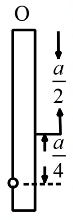
A particle of mass m is attached to a thin uniform rod of length a and mass 4m. The distance of the particle from the centre of mass of the rod is 2a.
The moment of inertia of the combination about an axis passing through a normal to the rod is
A rigid body is rotating about its centre of mass; fixed at origin with an angular velocity ω and angular acceleration α. If the torque acting on it is τ and its angular momentum is L, then the rate of change of its kinetic energy is
A rigid frictionless rod rotates anticlockwise in a vertical plane with angular velocity ω. A bead of mass m moves outward along the rod with constant velocity u0 . The bead will experience a coriolis force
The Lagrangian for a three-particle system is given by L=21(n˙12+n˙22+n˙32)−a2(n12+n22+n32−n1n3)
where, a is real, then one of the normal coordinates has a frequency ω given by