Which one of the following metal forming processes is the earing defect associated with?
A. Deep drawing
B. Rolling
C. Forging
D. Wire drawing
Select an option to see the answer and solution.
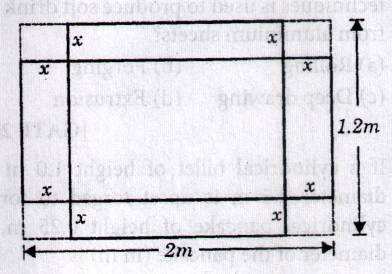
From a 2 m × 1.2m sheet, squares are Cut out from each of the four comers as shown in the figure and then the sides are bent to form an open box. The maximum possible volume (in m
3 ) of the box is
Select an option to see the answer and solution.
Match the following products to their method of manufacture.
P. Seamless tubes
1. Deep drawing
Q. Aluminium toothpaste tubes
2. Stamping
R. Currency coins
3. Impact extrusion
S. Car bodies
4. Roll piercing or extrusion
A. P-4, Q-3, R-2, S-1
B. P-4, Q-3, R-1, S-2
C. P-3, Q-4, R-1, S-2
D. P-2, Q-3, R-1, S-4
Select an option to see the answer and solution.
For ideal defect free deep drawability of material, it should have
A. low plastic anisotropy and low planer anisotropy
B. low plastic anisotropy and high planer anisotropy
C. high plastic anisotropy and low planer anisotropy
D. high plastic anisotropy and high planer anisotropy
Select an option to see the answer and solution.
Match the mechanical behaviour in
Group 1 with the terms in
Group 2 .
Group 1 Group 2
P. Low cycle fatigue
1. Charpy test
Q. Creep
2. Portevin-LeChatelier effect
R. Impact toughness
3. Coffin-Manson equation
S. Stretcher strains
4. Larson-Miller parameter
5. Jominy test
A. P-2, Q-4, R-1, S-5
B. P-2, Q-1, R-5, S-3
C. P-3, Q-4, R-1, S-2
D. P-2, Q-1, R-4, S-5
Select an option to see the answer and solution.
A wedge shaped piece of copper is plastically deformed to a plate of uniform thickness. The finest recrystallised grains will be observed at
A. the end of the plate corresponding to the thinner part of the wedge
B. the end of the plate corresponding to the thicker part of the wedge
C. in the centre of the plate
D. at no particular location of the plate
Select an option to see the answer and solution.
In sheet metal forming, stretcher strains occur in
A. duralumin sheets
B. low carbon steel sheets
C. austenitic stainless steel sheet
D. Ni-base alloy sheet
Select an option to see the answer and solution.
Which of the following is a typical rolling defect?
A. Buckling
B. Edge cracking
C. Cold shut
D. Porosity
Select an option to see the answer and solution.
Earing is a defect found in steels after the following metal working operation (s)?
A. Deep drawing
B. Rolling
C. Extrusion
D. Wire drawing
Select an option to see the answer and solution.
Identify the correct metal forming operations in
Group 1 with the product in
Group 2 .
Group 1 Group 2
P. Drawing
1. Tailoring needles
Q. Cold forging
2. Beverage cans
R. Extrusion
3. Radiator caps
S. Swaging
4. Steel half domes
A. P-1, Q-4, R-2, S-3
B. P-1, Q-2, R-3, S-4
C. P-2, Q-3, R-4, S-1
D. P-1, Q-3, R-2, S-4
Select an option to see the answer and solution.
For the manufacture of thin foil of aluminium, the following rolling mill is used:
A. Three high rolling mill
B. Sendzimir mill
C. Four stand continuous mill
D. Planetary mill
Select an option to see the answer and solution.
If a cylindrical billet of height 1.0 m and diameter 0.5 m is upset forged to form a cylindrical pancake of height 0.25 m, the diameter of the pancake (in m) is
Select an option to see the answer and solution.
The most serious manufacturing defect from fracture toughness point of view is
A. surface roughness
B. pore
C. spherical inclusion
D. crack
Select an option to see the answer and solution.
Match the processes given in
Group 1 with corresponding typical defects in
Group 2 .
Group 1 Group 2
P. Forging
1. Alligatoring
Q. Rolling
2. Cold shut
R. Deep drawing
3. Chevron Cracks
S. Extrusion
4. Wrinkles
A. P-1, Q-2, R-3, S-4
B. P-2, Q-1, R-4, S-3
C. P-2, Q-1, R-3, S-4
D. P-3, Q-1, R-4, S-2
Select an option to see the answer and solution.
Match the deformation processes in
Column I with the corresponding stress states listed in
Column II .
Column I Column II
P. Wire Drawing
1. Direct Compression
Q. Forging
2. Indirect Compression
R. Stretch Forming
3. Tension
S. Cutting
4. Shear
A. P-1, Q-2, R-3, S-4
B. P-1, Q-2, R-4, S-3
C. P-2, Q-1, R-3, S-4
D. P-2, Q-1, R-4, S-3
Select an option to see the answer and solution.
Match the fracture processes in
Group 1 to the fracture surface morphologies in
Group 2 .
Group 1 Group 2
P. Ductile fracture
1. Clevage
Q. Brittle fracture
2. Dimples
R. Fatigue fracture
3. Striations
4. Veins
A. P-4, Q-2, R-3
B. P-2, Q-1, R-3
C. P-2, Q-3, R-1
D. P-4, Q-4, R-3
Select an option to see the answer and solution.
The maximum possible reduction in a single pass for cold rolling of a 200 mm slab is (given the co-efficient of friction 0.1 and roll diameter is 400 mm) . . . . . . . . mm.
Select an option to see the answer and solution.
Patenting process is a
A. wire drawing process
B. heat treatment for drawn wires
C. coating process for wires
D. deep drawing process
Select an option to see the answer and solution.
Match the following components with their method of production.
P. Automobile crankshaft
1. Powder metallurgy
Q. Boiler drum
2. Submerged arc welding
R. Tungsten
3. Extrusion
S. Seamless tube
4. Forging
A. P-4, Q-2, R-3, S-1
B. P-4, Q-2, R-1, S-3
C. P-4, Q-3, R-2, S-1
D. P-3, Q-2, R-4, S-1
Select an option to see the answer and solution.
A steel plate of 10 mm thickness is to be cold rolled. The mill has rolls of diameter 72 mm. If the co-efficient of friction μ = 0.3 the maximum possible thickness reduction in the first pass will approximately be . . . . . . . . %.
Select an option to see the answer and solution.