Separation of particles of various sizes, shapes & densities by allowing them to settle in a fluid is called
A. classification
B. froth floatation
C. Thickening
D. none of these
Select an option to see the answer and solution.
During filtration operation, the filtrate encounters the resistance of the
A. filter medium
B. cake
C. channel carrying the slurry to then upstream side of the cake and filtrate away from the filter medium
D. all A, B and C
Select an option to see the answer and solution.
Match the following:
Group 1 Group 2
P. Floatation
1. Separation on the basis of density difference
Q. Electrostatic concentration
2. Reduction in size
R. Comminution
3. Surface charge is induced in particles
S. Heavy media separation
4. Modification of surface tension
A. P-2, Q-1, R-4, S-3
B. P-1, Q-2, R-3, S-4
C. P-3, Q-4, R-1, S-2
D. P-4, Q-3, R-2, S-1
Select an option to see the answer and solution.
The capacity of a pneumatic conveying system depends upon the
A. bulk density of materials
B. pressure of the conveying air
C. diameter of the conveying line
D. all A, B and C
Select an option to see the answer and solution.
The energy consumed by a ball mill depends upon
A. its speed
B. its ball load
C. the density of the material being ground
D. all A, B and C
Select an option to see the answer and solution.
Equivalent diameter of a particle is the diameter of the sphere having the same as the actual particle.
A. ratio of surface to volume
B. ratio of volume to surface
C. volume
D. surface
Select an option to see the answer and solution.
Hydrocyclone is a
A. crusher
B. wet classifier
C. dry
D. magnetic separator
Select an option to see the answer and solution.
In the floatation process, pine oil is used as
A. collector
B. activator
C. frother
D. depressant
Select an option to see the answer and solution.
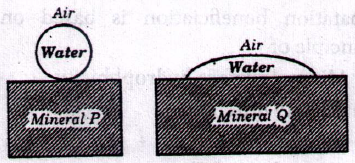
The figure below shows a schematic of a water droplet placed on the surfaces of two mineral P and Q.
Given this information, pick the correct statement from the following:
A. Mineral P ascends with air bubbles preferentially over mineral Q
B. Mineral Q ascends with air bubbles preferentially over mineral P
C. Both minerals P and Q ascend with the air bubbles without preference
D. Both minerals P and Q sink to the bottom
Select an option to see the answer and solution.
Which is a secondary crusher for a hard & tough stone?
A. jaw crusher
B. cone crusher
C. impact crusher
D. toothed roll crusher
Select an option to see the answer and solution.
The most efficient equipment for removal of sub-micronic dust particles from blast furnace gas is the
A. venturi atomizer
B. gravity settling chamber
C. electro-static precipitator
D. cyclone separator
Select an option to see the answer and solution.
Impurities present with minerals is called
A. Ore
B. minerals
C. gangue
D. none of these
Select an option to see the answer and solution.
The material is crushed in a gyratory crusher by the action of
A. impact
B. compression
C. attrition
D. cutting
Select an option to see the answer and solution.
Mechanical efficiency of a crusher is defined as the ratio of the
A. energy supplied to the crusher to the energy created by crushing
B. surface energy created by crushing to the energy supplied to the crusher
C. energy absorbed by the solid to the energy Supplied to the crusher
D. surface energy created by crushing to the energy absorbed by the solid
Select an option to see the answer and solution.
200 mesh sieve size corresponds to . . . . . . . . microns.
Select an option to see the answer and solution.
In case of a ball mil,
A. a coarse feed requires a larger ball
B. fine feed requires a larger ball
C. operating speed should be more than critical speed
D. none of these
Select an option to see the answer and solution.
The aperture size (in μm) of a 200 mesh sieve having a wire diameter of 53 μm is
Select an option to see the answer and solution.
Match the following processes with their physical principles.
Group 1 Group 2
P. Floatation
1. Difference in specific gravity
Q. Jigging
2. Difference in hydrophobicity
R. Heavy media separation
3. Difference in lateral movements
S. Tabling
4. Differential initial accelaration
A. P-4, Q-2, R-1, S-3
B. P-2, Q-4, R-1, S-3
C. P-4, Q-3, R-2, S-1
D. P-1, Q-2, R-3, S-4
Select an option to see the answer and solution.
The grinding in hammer crusher takes place due to
A. attrition
B. impact
C. both A and B
D. neither A nor B
Select an option to see the answer and solution.
Match the unit operation in
Group I with its corresponding principal in
Group II :
Group I Group II
P. Jigging
1. Modification of surface tension
Q. Tabling
2. Difference in density
R. Heavy media separation
3. Differential initial acceleration
S. Flotation
4. Differential lateral movement
A. P-3, Q-4, R-2, S-1
B. P-2, Q-3, R-1, S-4
C. P-4, Q-2, R-3, S-1
D. P-1, Q-3, R-2, S-4
Select an option to see the answer and solution.