In fluid flow, heat and mass transfer, one encounters (i) kinematic viscosity μ (ii) molecular diffusivity (θ) and (iii) thermal diffusivity (α) the units of these quantities are:
A. μ, α and θ all have units of m/s
B. μ α and θ all have units of m2 /s
C. μ and θ have units of m2 /s while μ has units of m/s
D. μ and θ have units of m/s while μ has units of m2 /s
Select an option to see the answer and solution.
Dislocations are
A. non-equilibrium defects
B. equilibrium defects
C. can't say
D. none of these
Select an option to see the answer and solution.
Nusselt number/Biot number varies
A. inversely with thermal conductivity
B. directly with heat transfer co-efficient
C. directly with thermal conductivity
D. inversely with dimension of the solid
Select an option to see the answer and solution.
Maximum upper critical temperature in iron carbon diagram is
A. 1147°C
B. 910°C
C. 1497°C
D. 210°C
Select an option to see the answer and solution.
In general, the ratio of mixing time and circulation in bioreactor is
Select an option to see the answer and solution.
What are the applications of cold rolled steel
A. Metal Furniture & containers
B. Water Heater & frying pans
C. Structural parts
D. All of these
Select an option to see the answer and solution.
Consider the following collection of polymer chains.
No. of molecules
10
5
4
2
1
Molecular weight gm.mol-1
2800
3000
1200
3600
1000
Mer unit is ethylene. Atomic weights: carbon (12) and, hydrogen (1). Calculate number average degree of polymerisation.
A. 32.32
B. 90.91
C. 106.61
D. 116.13
Select an option to see the answer and solution.
. . . . . . . . theory is applied for plastic deformation
A. Von Mises
B. Griffth
C. Bhor
D. Orwan
Select an option to see the answer and solution.
Glycogen, a naturally occurring polymer stored in animals is a
A. monosaccharide
B. disaccharide
C. trisaccharide
D. polysaccharide
Select an option to see the answer and solution.
Gray cast iron is usually welded by
A. Gas welding
B. Resistance welding
C. Arc welding
D. All of these
Select an option to see the answer and solution.
The following thermo couple may be used for measuring temperature upto 1873 K.
A. chromel-alumel
B. copper-constantan
C. platinum-platinum rhodium
D. iron-constant
Select an option to see the answer and solution.
Which of the following facts about dislocations is false?
A. No dislocations = extremely strong material
B. Presence of dislocation weakens material
C. No dislocations = extremely ductile material
D. A lot of dislocations = strong material
Select an option to see the answer and solution.
A screw dislocation has
A. Compressive stress fields
B. tensile stress fields
C. Compressive and tensile stress fields depending on situations
D. Shear stress fields
Select an option to see the answer and solution.
. . . . . . . . is that flow in which density fluid remains almost constant throughout flow.
A. Compressible flow
B. Compressibility
C. Incompressible flow
D. None of these
Select an option to see the answer and solution.
Particulate reinforcements have . . . . . . . . dimensions in all directions.
A. Equal
B. unequal
C. greater
D. lesser
Select an option to see the answer and solution.
. . . . . . . . decides the formation of vortex in stir casting process.
A. stir speed
B. number of blades
C. blade angle
D. none of these
Select an option to see the answer and solution.
Attraction force between dislocations of opposite sign is . . . . . . . .
Select an option to see the answer and solution.
In general, strongest polymer group is
A. Thermoplasts
B. Thermosets
C. Elastomers
D. All polymers
Select an option to see the answer and solution.
At steady state and when the inner and outer walls of a long hollow cylinder are kept at two different temperatures, the unidirectional temperature variation along the thickness of the wall is
A. linear
B. parabolic
C. logarithmic
D. constant
Select an option to see the answer and solution.
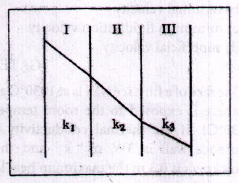
A furnace wall is made of three materials (I, II and III) of equal thickness and having thermal conductivity k
1 k
2 and k
3 respectively. The steady state temperature profile inside each material is shown in the figure. Thermal conductivities of the materials will vary as
A. k1 > k2 > k3
B. k2 > k1 > k3
C. k3 > k1 > k2
D. k3 > k2 > k1
Select an option to see the answer and solution.