Transistors act basically as voltage sources.
Select an option to see the answer and solution.
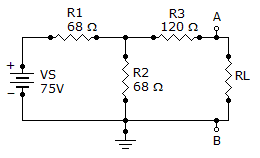
Find RN for the circuit given.
A. 34 Ω
B. 68 Ω
C. 120 Ω
D. 154 Ω
Select an option to see the answer and solution.
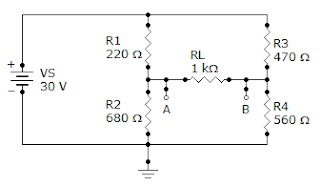
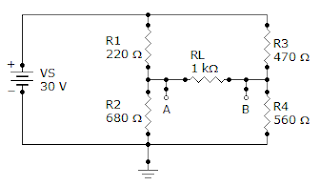
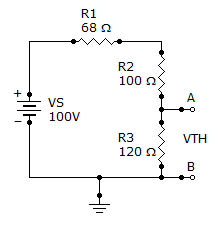
What is the Thevenin equivalent (V
TH and R
TH ) for the circuit given?
A. 6.4 V, 422 Ω
B. 6.4 V, 560 Ω
C. 6.4 V, 680 Ω
D. 30 V, 422 Ω
Select an option to see the answer and solution.
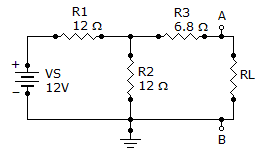
Determine
I N for the circuit consisting of VS, R1, R2 and R3 shown in the given circuit.
A. 676 mA
B. 245 mA
C. 431 mA
D. 75 mA
Select an option to see the answer and solution.
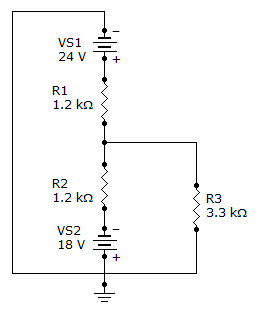
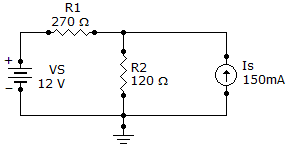
Find the total current through R3 in the given circuit.
A. 7.3 mA
B. 5.5 mA
C. 12.8 mA
D. 1.8 mA
Select an option to see the answer and solution.
Find the current through R2 of the given circuit.
A. 30.7 mA
B. 104 mA
C. 74 mA
D. 134 mA
Select an option to see the answer and solution.
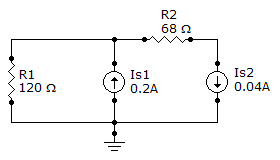
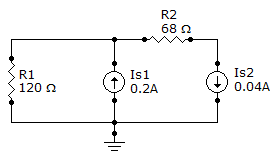
Find the current through R1 in the given circuit.
A. 0.16 A
B. 0.24 A
C. 0.2 A
D. 0.04 A
Select an option to see the answer and solution.
Referring to the given circuit, the voltage and current for the load resistor, RL, is
A. 450 mV, 4.5 mA
B. 4.50 V, 45 mA
C. 4.50 V, 4.5 mA
D. 450 mV, 45 mA
Select an option to see the answer and solution.
A 2 Ω RL is connected across a voltage source, VS, of 110 V. The source's internal resistance is 24 Ω. What is the output voltage across the load?
A. 8.5 V
B. 85 V
C. 0 V
D. 110 V
Select an option to see the answer and solution.
A 470 Ω RL is connected across a voltage source, VS, of 120 V. The source's internal resistance, RS, is 12 Ω. What is the output voltage across the load?
A. 120 V
B. 0 V
C. 117 V
D. 12 V
Select an option to see the answer and solution.
Conversions between delta-type and wye-type circuit arrangements are useful in certain specialized applications.
Select an option to see the answer and solution.
Find the Norton circuit, that is, I
IN and R
N , for the circuit given below.
A. 478 mA, 12.8 Ω
B. 750 mA, 12.8 Ω
C. 478 mA, 6.8 Ω
D. 750 mA, 6.8 Ω
Select an option to see the answer and solution.
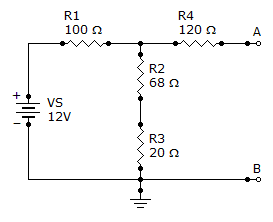
Find the Thevenin equivalent (VTH and RTH) between terminals A and B of the circuit given below.
A. 4.16 V, 120 Ω
B. 41.6 V, 120 Ω
C. 4.16 V, 70 Ω
D. 41.67 V, 70 Ω
Select an option to see the answer and solution.
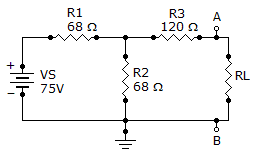
Referring to circuit given, if R1 is changed to a 68 Ω resistor, what will be the current through it?
A. 0.16 A
B. 0.24 A
C. 0.2 A
D. 0.04 A
Select an option to see the answer and solution.
A 120 Ω load is connected across an ideal voltage source with VS = 12 V. The voltage across the load is
A. 0 V
B. 12 V
C. 120 V
D. Cannot be determined
Select an option to see the answer and solution.
A 120 Ω load is connected across a voltage source with VS = 12 V and RS = 8 Ω. The voltage across the load is
A. 11.25 V
B. 0 V
C. 12 V
D. 1.13 V
Select an option to see the answer and solution.
A 12 V source has an internal resistance of 90 Ω. If a load resistance of 20 Ω is connected to the voltage source, the load power, PL, is
A. 2.38 mW
B. 2.38 W
C. 238 mW
D. 23.8 W
Select an option to see the answer and solution.
An 18 V source has an internal resistance of 70 Ω. If a load resistance of 33 Ω is connected to the voltage source, the load power, PL, is
A. 0 W
B. 1 W
C. 175 mW
D. 18 mW
Select an option to see the answer and solution.
Some circuits require more than one voltage or current source.
Select an option to see the answer and solution.
Referring to the given circuit, determine V
TH and R
TH if a 68 Ω resistor is connected in parallel across R2 and R3.
A. 3.3 V, 148 Ω
B. 330 mV, 148 Ω
C. 3.3 V, 68 Ω
D. 330 mV, 68 Ω
Select an option to see the answer and solution.