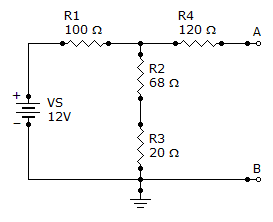
Find the Thevenin equivalent (V
TH and R
TH ) between terminals A and B of the circuit given.
A. 562 mV, 167 Ω
B. 5.62 V, 167 Ω
C. 5.62 V, 188 Ω
D. 562 mV, 188 Ω
Select an option to see the answer and solution.
In a two-source circuit, one source acting alone produces 12 mA through a given branch. The other source acting alone produces 10 mA in the opposite direction through the same branch. The actual current through the branch is
A. 22 mA
B. 12 mA
C. 10 mA
D. 2 mA
Select an option to see the answer and solution.
An ideal current source has zero internal resistance.
Select an option to see the answer and solution.
A practical voltage source has a nonzero internal resistance.
Select an option to see the answer and solution.
An ideal voltage source has zero internal resistance.
Select an option to see the answer and solution.
A practical current source has a finite internal resistance.
Select an option to see the answer and solution.
A 680 Ω load resistor, RL, is connected across a constant current source of 1.2 A. The internal source resistance, RS, is 12 kΩ. The load current, RL, is
A. 0 A
B. 1.2 A
C. 114 mA
D. 1.14 A
Select an option to see the answer and solution.
The Thevenin equivalent voltage (VTH ) is the short-circuit voltage between two terminals in a circuit.
Select an option to see the answer and solution.
A 120 V voltage source has a source resistance, RS, of 60 Ω. The equivalent current source is
A. 2 A
B. 4 A
C. 200 mA
D. 400 mA
Select an option to see the answer and solution.
A 12 mA current source has an internal resistance, RS, of 1.2 kΩ. The equivalent voltage source is
A. 144 V
B. 14.4 V
C. 7.2 V
D. 72 mV
Select an option to see the answer and solution.
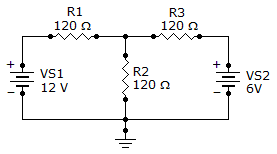
Find the current in R2 of the given circuit, using the superposition theorem.
A. 16.7 mA
B. 33.3 mA
C. 50 mA
D. 16.6 mA
Select an option to see the answer and solution.
Norton's equivalent current (IN) is an open-circuit current between two points in a circuit.
Select an option to see the answer and solution.
A certain voltage source has the values VS = 30 V and RS = 6 Ω. The values for an equivalent current source are
A. 5 A, 6 Ω
B. 30 A, 6 Ω
C. 5 A, 30 Ω
D. 30 A, 5 Ω
Select an option to see the answer and solution.
A certain current source has the values IS = 4 µA and RS = 1.2 MΩ. The values for an equivalent voltage source are
A. 4.8 µV, 1.2 MΩ
B. 1 V, 1.2 MΩ
C. 4.8 V, 4.8 MΩ
D. 4.8 V, 1.2 MΩ
Select an option to see the answer and solution.
You cannot convert a voltage source to an equivalent current source, or vice versa.
Select an option to see the answer and solution.