A composite R-C network yielded the following transfer function when calculated from its components: T(s)=R(s)C(s)=1+11s+10s21+21s+20s2
This network can be used as which one of the following?
For a state space representation of a system {\rm{A}} = \left[ {\begin{array}{*{20}{c}}
0&1\\
{ - 3}&{ - 2}
\end{array}} \right],\,{\rm{B}} = \left[ \begin{array}{l}
0\\
1
\end{array} \right] and C = [1 2] . Then transfer function of system would be:
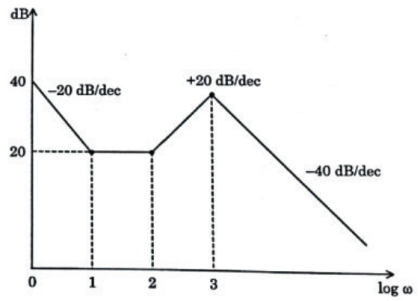
Consider the following statements regarding the asymptotic Bode plots used for frequency response analysis:
1. The deviation of the actual magnitude response for a zero on real axis is 3 dB at the corner frequency.
2. The phase angle for a pair of complex conjugate poles at undamped frequency depends upon the value of damping ratio.
Which of the statements given above is/are correct?
A unity feedback system has G(s)=s(4s+1)(s+1)2K(2s+1)
What is the value of K if the steady-state value of error is to be less than 0.1 when an input r(t) = 1 + 5t is applied?
If the output of the system at steady state doesn't agree with the input, then the system is said to have . . . . . . . . which determines the . . . . . . . . of the system.
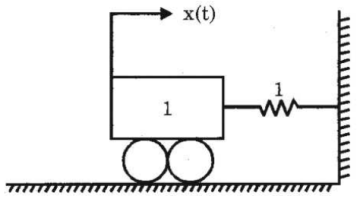
Consider the mechanical system shown in the given figure. If the system is set into motion by unit impulse force, the equation of the resulting oscillation will be:
A tachometer feedback is used as an inner loop in a position control servo-system. What is the effect of feedback on the gain of the sub-loop incorporating tachometer and on the effective time constant of the system?