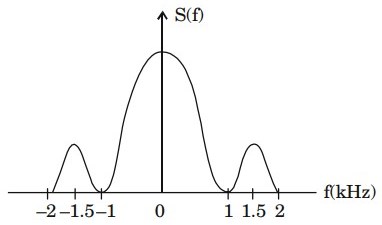
A 1.0 kHz signal is flat top sampled at the rate of 1800 samples/sec and the samples are applied to an ideal rectangular LPF with cut-off frequency of 1100 Hz, then the output of the filter contains
A 4 GHz carrier is DSB-SC modulated by a low pass message signal with maximum frequency of 2 MHz. The resultant signal is to be ideally sampled. The minimum frequency of the sampling impulse train should be
A video transmission system transmits 625 picture frames per second. Each frame consists of a 400 × 400 pixel grid with 64 intensity levels per pixel. The data rate of the system is
The raised cosine pulse p(t) is used for zero ISI in digital communications. The expression for p(t) with unity roll-off factor is given by p(t)=4πωt(1−16ω2t2)sin4πωt. The value of p(t) at t=4ω1 is
A sinusoidal signal of 2 kHz frequency is applied to a delta modulator. The sampling rate and step-size Δ of the delta modulator are 20,000 samples per second and 0.1 V, respectively. To prevent slope overload, the maximum amplitude of the sinusoidal signal (in Volts) is
Coherent orthogonal binary FSK modulation is used to transmit two equiprobable symbol waveforms s1(t) = αcos2πf1t & s2(t) = αcos2πf2t1 where α = 4 mV. Assume an AWGN channel with two-sided noise power spectral density 2N0=0.5×10⁻¹²W/Hz. Using an optimal receiver and the relation Q(v)=2π1v∫∞θ2u2du, the bit error probability for a data rate of 500 kbps is
During transmission over a certain binary communication channel, bit errors occur independently with probability p. The probability of AT MOST one bit in error in a block of n bits is given by
The message bit sequence to a DPSK modulator is 1, 1, 0, 0, 1, 1. The carrier phase during the reception of the first two message bits is π, π. The carrier phase for the remaining four message bits is
During transmission over a communication channel, bit errors occur independently with probability p. If a block of n bits is transmitted, the probability of at most one bit error is equal to
A signal having uniformly distributed amplitude in the interval (-V to + V), is to be encoded using PCM with uniform quantization. The signal to quantizing noise ratio is determined by the
Consider a binary digital communication system with equally likely 0's and 1's. When binary 0 is transmitted the detector input can lie between the levels -0.25V and +0.25V with equal probability: when binary 1 is transmitted, the voltage at the detector can have any value between 0 and 1 V with equal probability. If the detector has a threshold of 0.2 V (i.e., if the received signal is greater than 0.2 V, the bit is taken as 1), the average bit error probability is
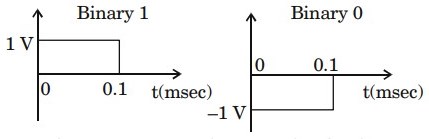
A source produces binary data at the rate of 10 kbps. The binary symbols are represented as shown in the figure.
The source output is transmitted using two modulation schemes, namely Binary PSK (BPSK) and Quadrature PSK (QPSK). Let and B2 be the bandwidth requirements of BPSK and QPSK respectively. Assuming that the bandwidth of the above rectangular pulses is 10 kHz, B1 and B2 are
Consider a Binary Symmetric Channel (BSC) with probability of error being p. To transmit a bit, say 1, we transmit a sequence of three 1 s. The receiver will interpret the received sequence to represent 1 if at least two bits are 1. The probability that the transmitted bit will be received in error is