A binary symmetric channel (BSC) has a transition probability of 81. If the binary transmit symbol X is such that P(X=0)=109, then the probability of error for an optimum receiver will be
A source emits bit 0 with probability 31 and bit 1 with probability 32. The emitted bits are communicated to the receiver. The receiver decides for either 0 or 1 based on the received value R. It is given that the conditional density functions of R as \begin{gathered}
{f_{R|0}}\left( r \right) = \left\{ {\begin{array}{*{20}{c}}
{\frac{1}{4},}&{ - 3 \leqslant r \leqslant 1} \\
{0,}&{{\text{otherwise;}}}
\end{array}} \right. \hfill \\
{f_{R|1}}\left( r \right) = \left\{ {\begin{array}{*{20}{c}}
{\frac{1}{6},}&{ - 1 \leqslant r \leqslant 5} \\
{0,}&{{\text{otherwise;}}}
\end{array}} \right. \hfill \\
\end{gathered}
The minimum decision error probability is
The minimum sampling frequency (in samples/sec) required to reconstruct the following signal from its samples without distortion x(t)=5(πtsin2π1000t)3+7(πtsin2π1000t)2
would be
A signal is sampled at 8 kHz and is quantized using 8-bit uniform quantizer. Assuming SNRq for a sinusoidal signal, the correct statement for PCM signal with a bit rate of R is
The bit stream 01001 is differentially encoded using 'Delay and Ex-OR' scheme for DPSK transmission. Assuming the reference bit as a '1' and assigning phases of '0' and 'π' for 1's and 0's respectively, in the encoded sequence, the transmitted phase sequence becomes
A sinusoidal signal with peak-to-peak amplitude of 1.536 V is quantized into 128 levels using a mid-rise uniform quantizer. The quantization noise power is
Four independent messages have bandwidths of 100 Hz, 100 Hz, 200 Hz, and 400 Hz, respectively. Each is sampled at the Nyquist rate, and the samples are Time Division Multiplexed (TDM) and transmitted. The transmitted sample rate (in Hz) is
In a baseband communications link, frequencies upto 3500 Hz are used for signaling. Using a raised cosine pulse with 75% excess bandwidth and for no inter-symbol interference, the maximum possible signaling rate in symbols per second is
An analog signal is band-limited to 4 kHz, sampled at the Nyquist rate and the samples are quantized into 4 levels. The quantized levels are assumed to be independent and equally probable. If we transmit two quantized samples per second, the information rate is
The minimum step-size required for a Delta-Modulator operating at 32 K samples/sec to track the signal (here u(t) is the unit-step function)
x(t) = 125t(u(t) - u(t - 1)) + (250 - 125t)(u(t - 1) - u(t - 2)) so that slope-overload is avoided, would be
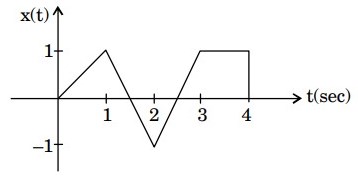
Consider the signal x(t) shown in the figure. Let h(t) denote the impulse response of the filter matched to x(t), with h(t) being non-zero only in the interval 0 to 4 sec. The slope of h(t) in the interval 3 < t < 4 sec is
If S represents the carrier synchronization at the receiver and p represents the bandwidth efficiency, then the correct statement for the coherent binary PSK is
In a digital communication system, transmissions of successive bits through a noisy channel are assumed to be independent events with error probability p. The probability of at most one error in the transmission of an 8-bit sequence is