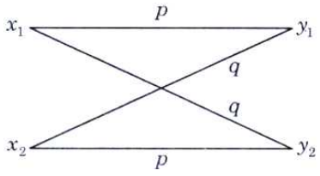
Consider a binary transmission of bits 0 and 1 with equal probability. Bits are transmitted in a noisy channel and channel noise is additive in nature. The received signal is random in nature with conditional probability density function for each transmitted bit 0 and 1, respectively, as
fr/0(x) = 1 - |x||x| < 1
fr/0(x) = 1 - |x - 1| 0 < x < 2
What is the average probability of error if threshold in the decision device at the receiving end is 1?
The capacity of a band-limited additive white Gaussian noise (AWGN) channel is given by C=Wlog2(1+σ2WP) bits per second (bps), where W is the channel bandwidth, P is the average power received and σ2 is the one-sided power spectral density of the AWGN.
For a fixed σ2P=1000, the channel capacity (in kbps) with infinite bandwidth (W→∞) is approximately
The entropy of a digital source is 2.7 bits/symbol. It is producing 100 different symbols per second. The source is likely to be which one of the following
What is the capacity of an additive white Gaussian noise channel with bandwidth of 1 MHz, power of 10 W and noise power spectral density of No/2 = 10(-9) W/Hz?
For Gaussian and White channel noise, the capacity of a low-pass channel with a usable bandwidth of 3000 Hz and S/N = 103 at the channel output will be
Given a channel with an intended capacity of 20 Mbits. The Bandwidth of this channel is 3 MHz. What is S/N ratio required in order to achieve this capacity?
A 8 kHz communication channel has an SNR of 30 dB. It the channel bandwidth is doubled, keeping the signal power constant, the SNR for the modified channel will be