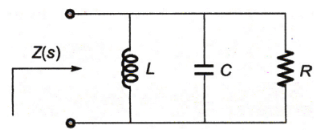
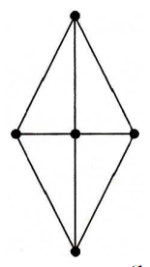
Consider the following statements regarding duality:
1. The dual networks are obtained for both AC and DC circuits and they are based on Kirchhoff's laws.
2. Dual circuits are not obtained in planar networks.
3. Two networks are said to be dual networks if mesh equations of one network have the same form as the nodal equation of the other.
Which of the above statements are correct?
A current of 5 A in primary coil of a circuit is reduced to zero at a uniform rate in 10-3 seconds. If coefficient of mutual inductance is 2 H, then the induced emf in the secondary coil is
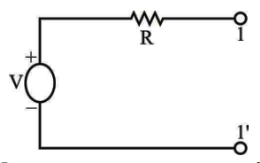
Thevenin equivalent circuit of a network N is shown above (at terminals 1-1').
To determine the value of R
1. all initial conditions are set to zero
2. all independent sources are turned off
3. all controlled sources are turned off
4. small load connected to terminals 1-1' (outside network N) is removed
Which are correct statements:
The resistance of a parallel circuit consisting of two resistors is 12 Ω. One of the resistance wires breaks and the effective resistance becomes 18 Ω. The resistance of the broken wire is
Two identical two-port networks having transmission matrix \left[ {\begin{array}{*{20}{c}}
{\text{A}}&{\text{B}} \\
{\text{C}}&{\text{D}}
\end{array}} \right] are cascaded. What will be the resultant transmission matrix of the cascade?
A particular current is made up of two components a 10 A dc and a sinusoidal current of peak value of 14.14 A. The average value of the resultant current is
The voltage applied to an R-L circuit at t = 0 when switch is closed at 100cos(100t + 30°). The circuit resistance is 80 Ω and inductance is 0.6 H (in which initial current is zero). What is the maximum amplitude of current flowing through the circuit?