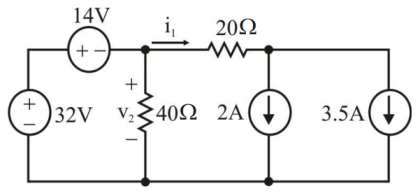
Determine the current i
1 in the network.
A. 3.5 A
B. 2 A
C. 5.5 A
D. 1.5 A
Select an option to see the answer and solution.
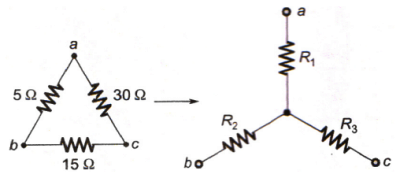
A delta-connected network with its Wye-equivalent is shown in the figure. The resistances R
1 , R
2 and R
3 (in ohms) are respectively
A. 1.5, 3 and 9
B. 3, 9 and 1.5
C. 9, 3 and 1.5
D. 3, 1.5 and 9
Select an option to see the answer and solution.
For a pair of lossless magnetically coupled coils with respective self inductances L1 , L2 (with L1 < L2 ) and mutual inductance M, the following is generally true.
A. M < L1 + L2
B. M2 < L1 L2
C. M < min(L1 + L2 )
D. L1 < M < L2
Select an option to see the answer and solution.
The input voltage V
1 and current I
1 for linear passive network is given by V
1 = AV
2 - BI
2 and I
1 = CV
2 - DI
2
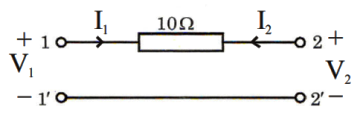
Now consider the following network:
Which one of the following is the transfer matrix
\left[ {\begin{array}{*{20}{c}}
{\text{A}}&{\text{B}} \\
{\text{C}}&{\text{D}}
\end{array}} \right] of the network shown above?
A. \left[ {\begin{array}{*{20}{c}}
1&0 \\
0&{10}
\end{array}} \right]
B. \left[ {\begin{array}{*{20}{c}}
1&{10} \\
0&1
\end{array}} \right]
C. \left[ {\begin{array}{*{20}{c}}
0&1 \\
{10}&0
\end{array}} \right]
D. \left[ {\begin{array}{*{20}{c}}
0&{10} \\
1&0
\end{array}} \right]
Select an option to see the answer and solution.
Consider the following properties of a particular network theorem:
A. Thevenin's theorem
B. Norton's theorem
C. Tellegen's theorem
D. Superposition theorem
Select an option to see the answer and solution.
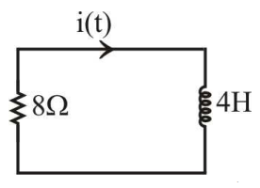
In the given circuit, the initial current i(0) = 20 Amp. Then the current in amperes at time t is:
A. 10 e-21
B. 12.5 et
C. 20 e-2t
D. 40 e-2t
Select an option to see the answer and solution.
Which of the following statements is false in case of a series circuit?
A. The voltage drop across each resistor is the same
B. The current flowing through each resistor is the same
C. Applied voltage is equal to the sum of the voltage drops across individual resistors
D. Resistors are additive
Select an option to see the answer and solution.
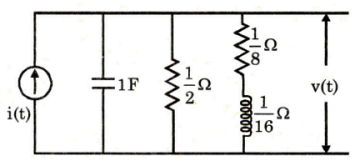
In the circuit shown in the figure, i(t) is a unit step current. The steady-state value of v(t) is
A. 2.5 V
B. 1 V
C. 0.1 V
D. zero
Select an option to see the answer and solution.
All poles and zeros of a driving point immittance function of an L-C network
A. should lie on the jω axis
B. should lie on the +ve real axis
C. should lie on the -ve real axis
D. can lie anywhere in s-plane
Select an option to see the answer and solution.
For a series RLC circuit, the power factor at the lowest half power frequency is
A. 0.707 lagging
B. 0.5 leading
C. 1.0
D. 0.707 leading
Select an option to see the answer and solution.
When two coils are connected in parallel and a voltage of 200 V is applied between the terminals, the total current taken by the circuit is 25 A and power dissipated in one of the coil is 1500 W, the resistance of each coil is
A. 25 Ω and 5 Ω
B. 26.67 Ω and 11.43 Ω
C. 0.25 Ω and 4.75 Ω
D. 35 Ω and 5 Ω
Select an option to see the answer and solution.
Find the energy expended moving a charge of 40 µC through a potential difference of 5 V:
A. 100 µJ
B. 150 µJ
C. 400 µJ
D. 200 µJ
Select an option to see the answer and solution.
A unit step voltage 2u(t - θ) is applied in a series RC circuit with R = 2 Ω, C = 1 F. Assuming zero initial conditions, find i(t).
A. i(t) = u(t)e-0.5(t) A
B. i(t) = u(t - 2θ)e-0.5(t - 2θ) A
C. i(t) = u(t - θ)e-0.5(t - θ) A
D. i(t) = u(t - θ)e-(t - θ) A
Select an option to see the answer and solution.
Voltage transfer function of a simple RC integrator has
A. a finite zero and a pole at infinity
B. a finite zero and a pole at the origin
C. a zero at the origin and a finite pole
D. a zero at infinity and a finite pole
Select an option to see the answer and solution.
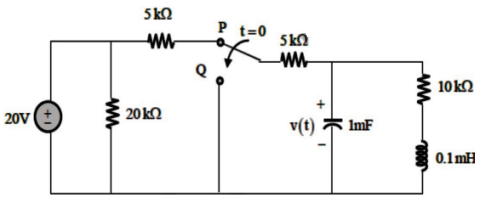
The switch in the circuit in the figure is in position P for a long time and then moved to position Q at time t = 0.
The value of
d t d v ( t ) at t = 0 + is
A. 3 V/s
B. -5 V/s
C. -3 V/s
D. 0 V/s
Select an option to see the answer and solution.
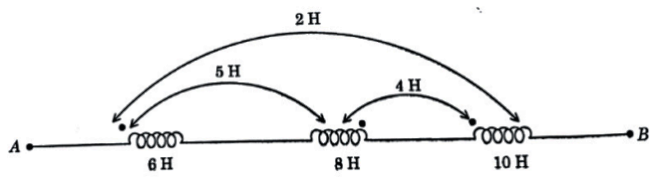
All the three inductors are perfectly coupled as shown below, the value of total inductance (in Henry) across the terminal AB is
Select an option to see the answer and solution.
Inductance has the dimensions of
A. Current Flux
B. Length Flux
C. Current ( Voltage ) 2
D. None of these
Select an option to see the answer and solution.
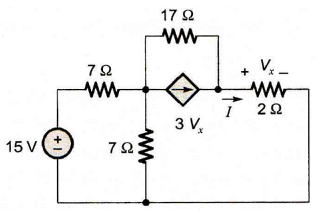
In the circuit shown in figure, the current through 2 Ω resistor is
A. -94.34 mA
B. -70.34 mA
C. 70.34 mA
D. 94.34 mA
Select an option to see the answer and solution.
For any lumped network, for any cut sets and at any instant of time the algebraic sum of all branch currents traversing the cut-set branches is always
A. One
B. Zero
C. Infinity
D. Greater than zero, but less than one
Select an option to see the answer and solution.
The circulating current in a parallel LC circuit at any resonant frequency is
A. directly proportional to frequency
B. inversely proportional to frequency
C. independent of frequency
D. none of the above
Select an option to see the answer and solution.