A system with input x[n] and output y[n] is given as y ( n ) = ( sin 6 5 π n ) x ( n ) .
A. Linear, stable and invertible
B. Non-linear, stable and non-invertible
C. Linear, stable and non-invertible
D. Linear, unstable and invertible
Select an option to see the answer and solution.
The Fourier transform of a voltage signal x(t) is X(f). The unit of |X(f)| is
A. Volt
B. Volt-sec
C. Volt/sec
D. Volt2
Select an option to see the answer and solution.
An excitation is applied to a system at t = land its response is zero for -∞ < t < T. Such a system is a
A. Non-causal system
B. Stable system
C. Causal system
D. Unstable system
Select an option to see the answer and solution.
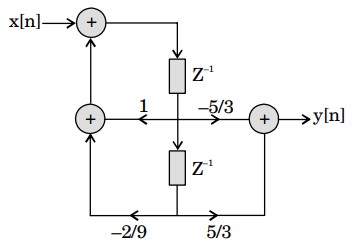
A realization of a stable discrete time system is shown in figure. If the system is excited by a unit step sequence input x[n], the response y[n] is
A. 4 ( − 3 1 ) n u [ n ] − 5 ( − 3 2 ) n u [ n ]
B. 5 ( − 3 2 ) n u [ n ] − 3 ( − 3 1 ) n u [ n ]
C. 5 ( − 3 1 ) n u [ n ] − 3 ( − 3 2 ) n u [ n ]
D. 5 ( − 3 2 ) n u [ n ] − 5 ( − 3 1 ) n u [ n ]
Select an option to see the answer and solution.
Match the following and choose the correct combination.
Group I Group II
E. Continuous and aperiodic signal
1. Fourier representation is continuous and aperiodic.
F. Continuous and periodic signal
2. Fourier representation is discrete and aperiodic.
G. Discrete and aperiodic signal
3. Fourier representation is continuous and periodic.
H. Discrete and periodic signal
4. Fourier representation is discrete and periodic.
A. E-3, F-2, G-4, H-1
B. E-1, F-3, G-2, H-4
C. E-1, F-2, G-3, H-4
D. E-2, F-1, G-4, H-3
Select an option to see the answer and solution.
If L[f(t)] = F(s), then L[f(t - T)] is equal to
A. esT F(s)
B. e-sT F(s)
C. 1 + e s T F ( s )
D. 1 − e − s T F ( s )
Select an option to see the answer and solution.
The impulse response h(t) of a linear time-invariant continuous time system is described by h(t) = exp(αt)u(t) + exp(βt)u(-t), where u(t) denotes the unit step function, and α and β are real constants. This system is stable if
A. α is positive and β is positive
B. α is negative and β is negative
C. α is positive and β is negative
D. α is negative and β is positive
Select an option to see the answer and solution.
Given thatL [ f ( t ) ] = s 2 + 1 s + 2 , L [ g ( t ) ] = ( s + 3 ) ( s + 2 ) s 2 + 1 , h ( t ) = 0 ∫ t f ( τ ) g ( t − τ ) d τ
A. s + 3 s 2 + 1
B. s + 3 1
C. ( s + 3 ) ( s + 2 ) s 2 + 1 + s 2 + 1 s + 2
D. None of the above
Select an option to see the answer and solution.
An FIR system is described by the system functionH ( z ) = 1 + 2 7 z − 1 + z 3 z − 2
A. Maximum phase
B. Minimum phase
C. Mixed phase
D. Zero phase
Select an option to see the answer and solution.
For a signal x(t) the Fourier transform is X(f). Then the inverse Fourier transform of X(3f + 2) is given by
A. 2 1 x ( 2 t e j 3 π t )
B. 2 1 x ( 2 t ) e − 3 j 4 π t
C. 3x(3t)e-j4πt
D. x(3t + 2)
Select an option to see the answer and solution.
The region of convergence of the z-transform of a unit step function is
A. |z| > 1
B. |z| < 1
C. (Real part of z) > 0
D. (Real part of z) < 0
Select an option to see the answer and solution.
The region of convergence of the z-transform of a unit step function is
A. |z| > 1
B. |z| < 1
C. (Real part of z) > 0
D. (Real part of z) < 0
Select an option to see the answer and solution.
Poles of Butterworth and Chebyshev low pass filters are located on . . . . . . . . and . . . . . . . . respectively in s-plane.
A. Ellipse, circle
B. Circle, ellipse
C. Circle, circle
D. Standard ellipse, tilted ellipse
Select an option to see the answer and solution.
Let function A = sinω0 t and B = sin(ω0 t + φ). The power of two signals; PA and PB is related as
A. PB = φPA
B. PB = ϕ 1 A
C. PB = tanφPA
D. PB = PA = P
Select an option to see the answer and solution.
Match
List-I with
List-II and select the correct answer using the options given below:
List-I (Time Function)List-II (Fourier Spectrum/Fourier Transform)
a. Periodic Function
1. Continuous spectrum at all frequencies
b. Aperiodic Function
2. -jπ{δ(ω - ω0 ) - δ(ω + ω0 )}
c. Unit Impulse δ(t)
3. Line discrete spectrum
d. sin ω(t)
4. 1
A. a-4, b-2, c-3, d-1
B. a-3, b-1, c-4, d-2
C. a-4, b-1, c-3, d-2
D. a-3, b-2, c-4, d-1
Select an option to see the answer and solution.
Which of the following is introduced in the frequency sampling realization of the FIR filter?
A. Poles are more in number on unit circle
B. Zeros are more in number on the unit circle
C. Poles and zeros at equally spaced points on the unit circle
D. None of the above
Select an option to see the answer and solution.
The convolution of f(t) with itself is given to be ∫ 0 t f ( τ ) d τ .
A. The unit ramp function
B. Equal to 1
C. The unit step function
D. The unit impulse function
Select an option to see the answer and solution.
If x[n] = -x[-n], then
A. n = − ∞ ∑ ∞ x [ n ] = 1
B. n = − ∞ ∑ ∞ x [ n ] = 0
C. n = 0 ∑ ∞ x [ n ] = 1
D. n = 0 ∑ ∞ x [ n ] = 0
Select an option to see the answer and solution.
A signal x(t) is band-limited to 2Hz, and y(t) = x3 (t) + x(t) + 1. The Nyquist sampling frequency of y(t) is:
A. 3 Hz
B. 6 Hz
C. 12 Hz
D. 27 Hz
Select an option to see the answer and solution.
The output of a system with impulse response δ[n - 2] to an input signal, u[n + 2] is:
A. u[n + 2]
B. u[n]
C. u[n - 2]
D. u[n] - u[n - 2]
Select an option to see the answer and solution.