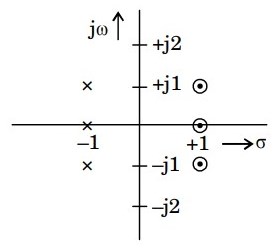
The impulse response h[n] of a linear time-invariant system is given by
h[n] = u[n + 3] + u[n - 2] - 2u[n - 7],
where u[n] is the unit step sequence. The above system is
Input x(t) and output y(t) of an LTI system are related by the differential equation y"(t) - y'(t) - 6y(t) = x(t). If the system is neither causal nor stable, the impulse response h(t) of the system is
A stable linear time invariant (LTI) system has a transfer function H(s)=s2+s−61. To make this system causal it needs to be cascaded with another LTI system having a transfer function H1(s). A correct choice for H1(s) among the following options is
A signal m(t) with bandwidth 500 Hz is first multiplied by a signal g(t) where g(t)=k=−∞∑∞(−1)kδ(t−0.5×10⁻⁴k)
The resulting signal is then passed through an ideal low pass filter with bandwidth 1 kHz. The output of the low pass filter would be
It is desired to find three-tap causal filter which gives zero signal as an output to and input of the form x[n]=c1exp(−2jπn)+c2exp(2jπn),
Where c1 and c2 are arbitrary real numbers. The desired three-tap filter is given by
h[0] = 1, h[1] = a, h[2] = b and h[n] = 0 for n < 0 or n > 2.
What are the values of the filter taps a and b if the output is y[n] = 0 for all n, when x[n] is as given above? \xrightarrow{{x\left[ n \right]}}\boxed{\begin{array}{*{20}{c}}
{n = 0} \\
\downarrow \\
{h\left[ n \right] = \left\{ {1,a,b} \right\}}
\end{array}}\xrightarrow{{y\left[ n \right] = 0}}
The input-output relationship of a causal stable LTI system is given as
y[n] = αy[n - 1] + βx[n]. If the impulse response h[n] of this system satisfies the condition n=0∑∞h[n]=2, the relationship between α and β is
The bilateral Laplace transform of a function f\left( t \right) = \left\{ {\matrix{
{1,} & {{\rm{if}}\,a \le t \le b} \\
0 & {{\rm{otherwise}}} \\
} } \right. is
{a(n)} is a real-valued periodic sequence with a period N. x(n) and X(k) form N-point Discrete Fourier Transform (DFT) pairs. The DFT Y(k) of the sequence y(n)=N1r=0∑N−1x(r)x(n+r) is