Match
List-I with
List-II in regard to Fourier series of periodic f(t) and select the correct answer using the options given below:
List-I (Properties)List-II (Characteristics of the trigonometric form)
a. f(t) + f(-t) = 0
1. Even harmonics can exist
b. f(t) - f(-t) = 0
2. Odd harmonics can exist
c. f ( t ) + f ( t − 2 T ) = 0
3. The dc and cosine terms can exist
d. f ( t ) − f ( t − 2 T ) = 0
4. sine terms can exist
5. cosine terms of even harmonics can exist
A. a-4, b-5, c-3, d-1
B. a-3, b-4, c-1, d-2
C. a-5, b-4, c-2, d-3
D. a-4, b-3, c-2, d-1
Select an option to see the answer and solution.
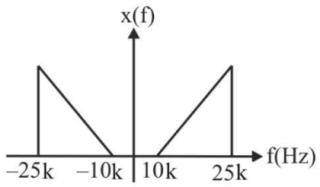
Find the sampling frequency (f
s ) in the below figure?
A. 50 kHz
B. 10 kHz
C. 30 kHz
D. 40 kHz
Select an option to see the answer and solution.
The poles of a digital filter with linear phase response can lie
A. only at z = 0
B. only on the unit circle
C. only inside the unit circle but not at z = 0
D. on the left side of Real (z) = 0 line
Select an option to see the answer and solution.
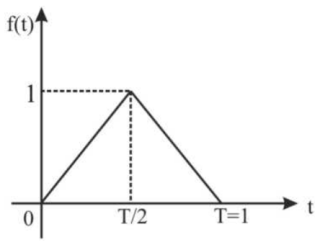
Laplace transform of the function f(t) shown in the figure is
A. s 2 2 [ 1 − e − 0.5 s ] 2
B. s 2 2 [ 1 + e − 0.5 s ] 2
C. s 2 2 [ 1 − e 0.5 s ] 2
D. s 2 2 [ 1 + e 0.5 s ] 2
Select an option to see the answer and solution.
A continuous time LTI system is described by d t 2 d 2 y ( t ) + 4 d t d y ( t ) + 3 y ( t ) = 2 d t d x ( t ) + 4 x ( t ) -2t u(t) is given by
A. (et - e3t )u(t)
B. (e-t - e-3t )u(t)
C. (e-t + e-3t )u(t)
D. (et + e3t )u(t)
Select an option to see the answer and solution.
A periodic triangular wave is shown in the figure. Its Fourier components will consist only of
A. all cosine terms
B. all sine terms
C. odd cosine terms
D. odd sine terms
Select an option to see the answer and solution.
A discrete time, which is both linear and time invariant, the impulse response is u[n]. What is the response of the system for an input δ[n - 4]?
A. u[n - 2]
B. u[n - 4]
C. u[n + 2]
D. u[n + 4]
Select an option to see the answer and solution.
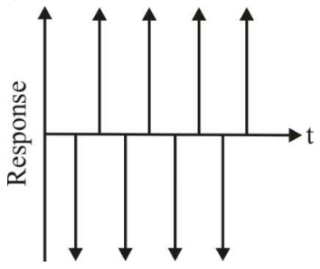
The impulse response of a discrete system with a simple pole is shown in the given figure
The pole must be located
A. on the real axis at z = 1
B. at the origin of the z-plane
C. on the real axis at z = -1
D. at z = ∞
Select an option to see the answer and solution.
The impulse response of a continuous time system is given by h(t) = δ(t - 1) + δ(t - 3). The value of the step response at t = 2 is
Select an option to see the answer and solution.
A time invariant system is a system whose output
A. increases with a delay in input
B. decreases with a delay in input
C. remains same with a delay in input
D. vanishes with a delay in input
Select an option to see the answer and solution.
The system that is sometimes represented symbolically as x[n] → y[n] is called:
A. Unit impulse system
B. Continuous-time system
C. Unit step system
D. Discrete-time system
Select an option to see the answer and solution.
If ROC1 is the region of convergence of x(n) and ROC2 is the region of convergence of y(n), then x(n) ∗ y(n) is . . . . . . . .
A. ROC1 Union ROC2
B. ROC1 - ROC2
C. ROC1 Intersection ROC2
D. ROC1 + ROC2
Select an option to see the answer and solution.
The transfer function of a system Z ( s ) = I ( s ) V ( s ) = s + 3 s .
A. e-t
B. 4e-t
C. 2e-3t
D. 3t-3t
Select an option to see the answer and solution.
If L [ f ( t ) ] = ( s 2 + 2 s + 5 ) 2 ( s + 1 ) , + ) and f(∞) are given by
A. 0, 2 respectively
B. 2, 0 respectively
C. 0,1 respectively
D. 5 2 ,
Select an option to see the answer and solution.
The impulse function t 1 ∫ t 2 x ( t ) δ n ( t − t 0 ) d t
A. nx(t0 )
B. xn (t0 )
C. x(t0 )
D. (-1)n xn (t0 )
Select an option to see the answer and solution.
If a periodic waveform is half-wave symmetric, it must be represented by a function satisfying the relationship
A. f(t) = f(-t)
B. f(t) = -f(t + T/2)
C. f(t) = -f(-t)
D. f(t) = f(t + T/2)
Select an option to see the answer and solution.
Fourier transform is not possible for
A. u(t)
B. δ(t)
C. tu(t)
D. sinωo t
Select an option to see the answer and solution.
An IIR filter having numerator order M and denominator order N is to be realized using direct form II structure. How much total number of multiplications, additions and memory locations are required respectively?
A. M + N, M + N and {M + N}
B. M + N, M + N and maximum of [M, N]
C. M + N + 1, M + N + 1 and M + N
D. M + N + 1, M + N and maximum of {M, N}
Select an option to see the answer and solution.
Match
List-I with
List-II ) and select the correct answer using the options given below:
List-I (Input-output relation)List-II (Property of the system)
a. y(n) = x(n)
1. Nonlinear, non-causal
b. y(n) = x(n2 )
2. Linear, non-causal
c. y(n) = x2 (-n)
3. Linear, causal
d. y(n) = x2 (n)
4. Nonlinear, causal
A. a-1, b-4, c-3, d-2
B. a-3, b-2, c-1, d-4
C. a-1, b-2, c-3, d-4
D. a-3, b-4, c-1, d-2
Select an option to see the answer and solution.
Let x(t) ↔ X(jω) be Fourier Transform pair. The Fourier Transform of the signal x(5t - 3) in terms of X(jω) is given as
A. 5 1 e 5 − j 3 ω X ( 5 j ω )
B. 5 1 e 5 j 3 ω X ( 5 j ω )
C. 5 1 e − j 3 ω X ( 5 j ω )
D. 5 1 e j 3 ω X ( 5 j ω )
Select an option to see the answer and solution.