Fourier transform F(jω) of an arbitrary real signal has the property.
A. F(jω) = F(-jω)
B. F(jω) = -F(-jω)
C. F(jω) = F*(–jω)
D. F(jω) = -F*(-jω)
Select an option to see the answer and solution.
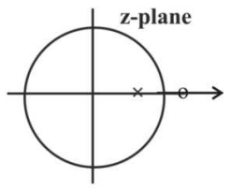
The pole-zero diagram of the system:
H ( z ) = z − a 1 − a z is represented by:
A. High pass
B. Low pass
C. All pass
D. Band pass
Select an option to see the answer and solution.
The required roll-off rate of the frequency response of an anti-aliasing filter will create problems in its design if
A. The sampling frequency is very high
B. The sampling frequency is only slightly more than the Nyquist rate
C. The sampling frequency is less than the Nyquist rate
D. Ideal sampling is employed
Select an option to see the answer and solution.
The impulse δ(t) and unit step function u(t) are related to each other as:
A. δ(t) = dt d
B. δ(t) = u(t) + u(2t - 1)
C. δ(t) = ∫u(t)dt
D. δ(t) = 2.u(t)
Select an option to see the answer and solution.
If a signal f(t) has energy E, the energy of the signal f(2t) is equal to
Select an option to see the answer and solution.
A discrete-time all-pass system has two of its poles at 0.25∠0° and 2∠30° which one of the following statements about the system is TRUE?
A. It has two more poles at 0.5∠30° and 4∠0°
B. It is stable only when the impulse response is two-sided
C. It has constant phase response over all frequencies
D. It has constant phase response over the entire z-plane
Select an option to see the answer and solution.
What is the spectral density of white noise?
A. A constant
B. δ(ω)
C. [δ(ω)]2
D. A step function in ω
Select an option to see the answer and solution.
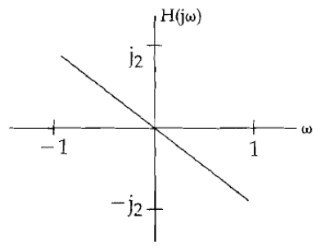
A causal LTI filter has the frequency response as shown in Fig. If input signal to filter is x(t) = e
-jt , then filter output will be:
A. -2je-jt
B. 2je-jt
C. 4πje-jt
D. -4πje-jt
Select an option to see the answer and solution.
A rectangular pulse of amplitude A and time duration Z is applied to be matched filter. Its maximum SNR is
A. η 2 A 2 Z
B. 2 η A 2 Z
C. η 2 A Z
D. η Z 2 A 2
Select an option to see the answer and solution.
The ROC of anti-causal sequence is:
A. Entire z - plane
B. Entire z - plane except z = 0
C. Entire z - plane except z = ∞
D. Entire z - plane except z = 1
Select an option to see the answer and solution.
The discrete equation y(n + 1) + 0.5ny(n) = 0.5x(n + 1) is not attributable to a
A. Memory less system
B. Time-varying system
C. Linear system
D. Causal system
Select an option to see the answer and solution.
Which one of the following systems is a causal system?
A. y(t) = sin(t + 3)
B. y(t) = u(t) + u(t - 1)
C. y(t) = u(t) + u(t + 1)
D. y(t) = sin(t - 3) + sin(t + 3)
Select an option to see the answer and solution.
The impulse response h[n] of a linear time-invariant system is given by h[n] = u[n + 3] + u[n - 2] - 2u[n - 7] where u[n] is the unit step sequence. The above system is
A. stable and causal
B. stable but not causal
C. unstable and not causal
D. causal but unstable
Select an option to see the answer and solution.
If z0 is a zero of a (real-valued) linear-phase FIR filter then following is/are also zero/zeros of a (real-valued) linear-phase FIR filter,
A. z 0 ∗
B. z 0 1
C. z 0 1 , z 0 ∗ and z 0 ∗ 1
D. z 0 1 and z 0 ∗ 1
Select an option to see the answer and solution.
A non zero DC signal pass through a low pass filter then output is
A. Less than input
B. more than input
C. Same as input
D. zero
Select an option to see the answer and solution.
It is possible to compute the cross-correlation Rxy (τ) between two signals x(t) and y(t) directly from their convolution provided
A. x(t) has even symmetry
B. x(t) has odd symmetry
C. y(t) has odd symmetry
D. y(t) has even symmetry
Select an option to see the answer and solution.
A discrete LTI system is non-causal if its impulse response is
A. an U(n - 2)
B. an - 2 U(n)
C. an + 2 U(n)
D. an U(n + 2)
Select an option to see the answer and solution.
The linear constant coefficient difference equation y ( n ) − 2 1 y ( n − 1 ) = x ( n ) + 3 1 x ( n − 1 )
A. X ( Z ) Y ( Z ) = 1 + 2 1 Z − 1 1 + 3 1 Z − 1
B. X ( Z ) Y ( Z ) = 1 − 2 1 Z − 1 1 − 3 1 Z − 1
C. X ( Z ) Y ( Z ) = 1 + 2 1 Z − 1 1 − 3 1 Z − 1
D. X ( Z ) Y ( Z ) = 1 − 2 1 Z − 1 1 + 3 1 Z − 1
Select an option to see the answer and solution.
If the lower limit of Region of Convergence (ROC) is greater than the upper limit of ROC, the series X ( z ) = ∑ n = − ∞ ∞ x ( n ) z − n
A. Converges
B. Zero
C. Does not converge
D. None of the above
Select an option to see the answer and solution.
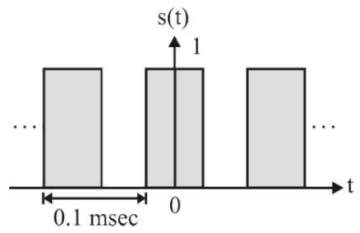
A rectangular pulse train s(t) as shown in the figure is convolved with the signal cos
2 (4π × 10
3 t). The convolved signal will be a
A. DC
B. 12 kHz sinusoid
C. 8 kHz sinusoid
D. 14 kHz sinusoid
Select an option to see the answer and solution.