A vibrational-electronic spectrum of homonuclear binary molecules, involving electronic ground state ε'' and excited ε', exhibits a continuum at v cm-1. If the total energy of the dissociated atoms in the excited state exceeds the total energy of the dissociated atoms in the ground state by Eex cm-1, then dissociation energy of the molecule in the ground state is
For a multi-electron atom l, L and S specify the one electron orbital angular momentum, total orbital angular momentum and total spin angular momentum respectively. The selection rules for electric dipole transition between the two electronic energy levels, specified by l, L and S are
A collection of N atoms is exposed to a strong resonant electromagnetic radiation with Ng atoms in the ground state and N atoms in the excited state, such that Ng + Ne = N. This collection of two-level atoms will have the following population distribution
Deuteron in its ground state has a total angular momentum J = 1 and a positive parity. The corresponding orbital angular momentum L and spin angular momentum S combinations are
Two monochromatic waves having frequencies ω and ω+Δω(Δω≪ω) and corresponding wavelengths λ and λ−Δλ(Δλ≪λ) of same polarization, travelling along X-axis are superimposed on each other. The phase velocity and group velocity of the resultant wave are respectively given by
A pure rotational Raman spectrum of a linear diatomic molecule is recorded using electromagnetic radiation of frequency νe . The frequency of two consecutive Stokes lines are
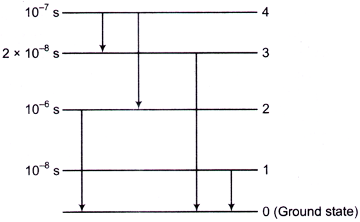
Five energy levels of a system including the ground state are shown below. Their lifetimes and the allowed electric dipole transitions are also marked.
Which one of the following transitions is the most suitable for a Continuous Wave (CW) laser?
When the refractive index μ of the active medium changes by Δμ in a laser resonator of length L, the change in the spectral spacing between the longitudinal modes of the laser is (c is the speed of light in free space)
For an electron in hydrogen atom, the states are characterized by the usual quantum numbers n, l, ml. The electric dipole transition between any two states requires that
X-rays were produced using cobalt (Z = 27) as target. It was observed that the X-ray spectrum contained a strong Kα line of wavelength 0.1785 nm an a weak Kα line of wavelength 0.1930 nm. Then the weak Kα line is due to an impurity whose atomic number is