The energy levels of a particle of mass m in a potential of the form V(x)=∞,x⩽0\hfill=21mω2x2,x>0\hfill are given, in terms of quantum number n = 0, 1, 2, 3, . . ., by
A^ and B^ represent two physical characteristics of a quantum system. If A^ is Hermitian, then for the product A^B^ to be Hermitian, it is sufficient that
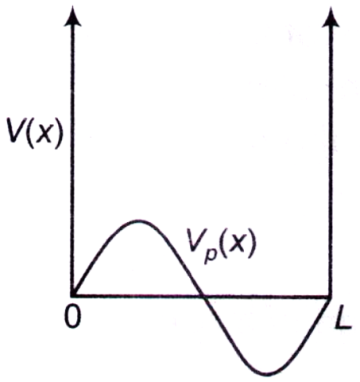
A particle of mass m is confined in an infinite potential well V\left( x \right) = \left\{ {\begin{array}{*{20}{c}}
{0,}&{{\text{if }}0 < x < L} \\
{\infty ,}&{{\text{otherwise}}}
\end{array}} \right.
It is subjected to a perturbing potential VP(x)=V0sin(L2πx) within the well. Let E(1) and E(2) be the corrections to the ground state energy in the first and second order in V0.
Which of the following is correct?
A particle is incident with a constant energy E on a one-dimensional potential barrier as shown in the figure.
The wave functions in regions I and II are respectively
Which one of the functions given below represents the bound state eigen function of the operator −dx2d2 in the region, 0 ≤ x < ∞ , with the eigen value -4?
A parallel beam of infrared radiation of wavelength of 1.01 × 10⁻⁶ m is incident normally on a screen with two slits 5 × 10⁻⁶ m apart and the resulting interference pattern is observed on a distant screen. What is the largest number of maxima that can be observed on the screen?
A quantum particle of mass m is confined to a square region in XOY-plane whose vertices are given by (0, 0), (L, 0), (L, L) and (0, L). Which of the following represents an admissible wave function of the particle (for I, m, n positive integers)?
If σ is the total cross-section and f(θ), θ being the angle of scattering, is the scattering amplitude for a quantum mechanical elastic scattering by a spherically symmetric potential, then which of the following is true? Note that k is the magnitude of the wave vector along the z^ direction.
A particle is moving in a spherically symmetric potential V(r) = αr2, where α is a positive constant. In a stationary state, the expectation value of the kinetic energy ⟨T⟩ of the particle is
A beam of mono-energetic particles having speed v is described by the wave function ψ (x) = u(x) exp(ikx), where u(x) is a real function. This corresponds to a current density
There are only three bound states for a particle of mass m in a one-dimensional potential well of the form shown in the figure. The depth V0 of the potential satisfies
A system in a normalized state ∣ψ⟩=c1∣α1⟩+c2∣α2⟩ with ∣α1⟩ and ∣α2⟩ representing two different eigen states of the system requires that the constants c1 and c2 must satisfy the condition
A particle of mass m is represented by the wave function ψ(x)=Aeikx, where k is the wave vector and A is a constant. The magnitude of the probability current density of the particle is