A classical particle is moving in an external potential field V(x, y, z) which is invariant under the following infinitesimal transformations \begin{array}{*{20}{c}}
{x \to x'}& = &{x + \delta x} \\
{y \to y'}& = &{y + \delta y} \\
{\left[ {\begin{array}{*{20}{c}}
x \\
y
\end{array}} \right] \to \left[ {\begin{array}{*{20}{c}}
{x'} \\
{y'}
\end{array}} \right]}& = &{{R_z}\left[ {\begin{array}{*{20}{c}}
x \\
y
\end{array}} \right]}
\end{array}
where, Rz is the matrix corresponding to rotation about the Z-axis. The conserved quantities are (the symbols have their usual meaning)
An atom emits a photon of wavelength λ = 600 nm by transition from an excited state of life time 8 × 10⁻⁹ s. If Δν represents the minimum uncertainty in the frequency of the photon, the fractional width νΔν of the spectral line is of the order of
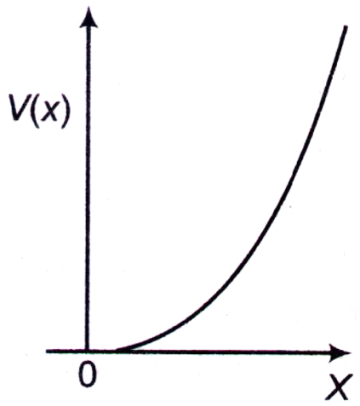
A particle of mass m is confined in the potential
V\left( x \right) = \left\{ {\begin{array}{*{20}{c}}
{\frac{1}{2}m{\omega ^2}{x^2},}&{{\text{for }}x < 0} \\
{\infty ,}&{{\text{for }}x \leqslant 0}
\end{array}} \right.
Let the wave function of the particle be given by ψ(x)=−51ψ0+52ψ1
where ψ0 and ψ1 are the eigen functions of the ground state and the first excited slate respectively. The expectation value of the energy is
The normalized ground state, wave function of a hydrogen atom is given ψ(r)=4π1a232−e−ar, where a is the Bohr radius and r is the distance of the electron from the nucleus located at the origin. The expectation value ⟨r21⟩ is
The wave function of a one-dimensional harmonic oscillator is ψ0=Aexp(2−α2x2) for the ground state E0=2ℏω, where α2=ℏmω in the presence of a perturbing potential of E0(10αx)4, the first order Change in the ground state energy is [Given, Γ(x+1)=∫0∞txexp(−t)dt]
A free particle with energy E whose wave function is a plane wave with wavelength λ enters a region of constant potential V > 0, where the wavelength of the particle is 2λ. The ratio (V/E) is
A one-dimensional random walker takes steps to left or right with equal probability. The probability that the random walker starting from origin is back to origin after N even number of steps is
An electron with energy E is incident from left on a potential barrier, given by V(x)=0 for x<0\hfill=V0 for x>0\hfill as shown in the figure.
For E < V0, the space part of the wave function for x > 0 is of the form
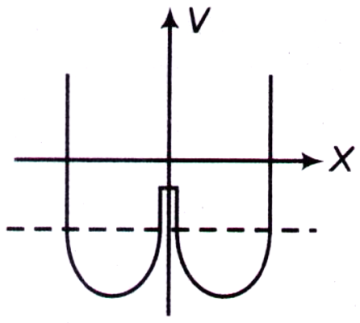
A particle with energy E is in a time independent double well potential as shown in the figure. Which, of the following statements about the particle is not correct?
A quantum harmonic oscillator is in the energy eigen state ∣n⟩. A time independent perturbation 1λ(ata)2 acts on the particle, where λ is a constant of suitable dimensions and a and at are lowering and raising operators respectively. Then the first order energy shift is given by
For a particle of mass m in a one-dimensional harmonic oscillator potential of the form V(x)=21mω2x2, the first excited energy eigen state is ψ(x)=xe−ax2. The value of a is