A system has two energy levels with energies E and 2E. The lower level is four-fold degenerate while the upper level is doubly degenerate. If there are N non-interacting classical particles in the system, which is in thermodynamic equilibrium at temperature T, the fraction of particles in the upper level is
A system of non-interacting Fermi particles with Fermi energy EF has the density of states proportional to √E, where E is the energy of a particle. The average energy
per particle at temperature T = 0 is
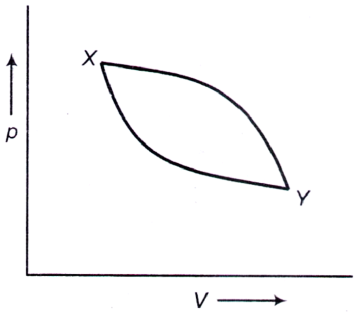
A piston containing an ideal gas is originally in the state X (see figure). The gas is taken through a thermal cycle X → Y → X as shown The work done by the gas is positive, if the direction of the thermal cycle is
In a classical micro-canonical ensemble for a system of N non-interacting particles, the fundamental volume in phase space which is regarded as equivalent to one micro-state is
(where, h is the Planck's constant.)
Consider the Fermi-Dirac distribution function f(E) at room temperature (300 K), where E refers tb energy. If EF is the Fermi energy, which of the following is true?
Which of the following conditions should be satisfied by the temperature T of a system of N non-interacting particles occupying a volume V, for Bose-Einstein condensation to take place?
(where, m is the mass of each particle of the system, kB is the Boltzmann constant, h is the Planck's constant and ξ is the well known zeta function.)
The equation of state of a dilute gas at very high temperature is described by kBTpV≈1+VB(T), where V is the volume per particle and B(T) is a negative quantity. One can conclude that this is a property of
Which of the following relations between the particle number density n and temperature T must hold good for a gas consisting of non-interacting particles to be described by quantum statistics?
A monatomic crystalline solid comprises of N atoms, out of which n atoms are in interstitial positions. If the available interstitial sites are N', then number of possible micro-states is
A heat pump working on the Carnot cycle maintains the inside temperature of a house at 22°C by supplying 450 kJ/s. If the outside temperature is 0°C, the heat taken, in kJ/s, from the outside air is approximately