Two forces are acting at an angle of 120°. The bigger force is 40 N and the resultant is perpendicular to the smaller one. The smaller force is
A. 20 N
B. 40 N
C. 120 N
D. None of these
Select an option to see the answer and solution.
The static friction
A. Bears a constant ratio to the normal reaction between the two surfaces
B. Is independent of the area of contact, between the two surfaces
C. Always acts in a direction, opposite to that in which the body tends to move
D. All of the above
Select an option to see the answer and solution.
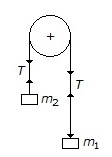
In the shown figure, the tension (T) in the string will be
A. m 1 + m 2 m 1 m 2 g
B. m 1 + m 2 2 m 1 m 2 g
C. m 1 m 2 g m 1 + m 2
D. 2 m 1 m 2 g m 1 + m 2
Select an option to see the answer and solution.
The term 'Centroid' is
A. The same as centre of gravity
B. The point of suspension
C. The point of application of the resultant of all the forces tending to cause a body to rotate about a certain axis
D. None of the above
Select an option to see the answer and solution.
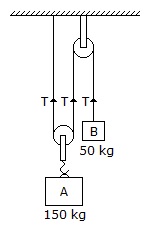
Two blocks ‘A’ and ‘B’ of masses 150 kg and 50 kg respectively are connected by means of a string as shown in the below figure. The tension in all the three strings __________ be same.
A. Will
B. Will not
C. Either A or B
D. None of these
Select an option to see the answer and solution.
The unit of angular acceleration is
Select an option to see the answer and solution.
The unit of angular velocity is
A. M/min
B. Rad/s
C. Revolutions/min
D. Both (B) and (C)
Select an option to see the answer and solution.
The unit of force in S.I. units is
A. Kilogram
B. Newton
C. Watt
D. Dyne
Select an option to see the answer and solution.
The unit of work in S.I. units is
A. Newton
B. Erg
C. Kg-m
D. Joule
Select an option to see the answer and solution.
The weight of a body is due to
A. Gravitational pull exerted by the earth
B. Forces experienced by body in atmosphere
C. Force of attraction experienced by particles
D. Gravitational force of attraction towards the centre of the earth
Select an option to see the answer and solution.
The wheels of a moving car possess
A. Potential energy only
B. Kinetic energy of translation only
C. Kinetic energy of rotation only
D. Kinetic energy of translation and rotation both
Select an option to see the answer and solution.
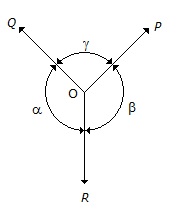
The below figure shows the three coplanar forces P, Q and R acting at a point O. If these forces are in equilibrium, then
A. sin β P = sin α Q = sin γ R
B. sin α P = sin β Q = sin γ R
C. sin γ P = sin α Q = sin β R
D. sin α P = sin γ Q = sin β R
Select an option to see the answer and solution.
If a number of coplanar forces acting at a point be in equilibrium, the sum of clockwise moments must be __________ the sum of anticlockwise moments, about any point.
A. Equal to
B. Less than
C. Greater than
D. None of these
Select an option to see the answer and solution.
A body of weight 'W' is required to move up on rough inclined plane whose angle of inclination with the horizontal is 'α'. The effort applied parallel to the plane is given by (where μ = tanφ = Coefficient of friction between the plane and the body.)
A. P = W tanα
B. P = W tan (α + φ)
C. P = W (sinα + μcosα)
D. P = W (cosα + μsinα)
Select an option to see the answer and solution.
The law of motion involved in the recoil of gun is
A. Newton's first law of motion
B. Newton's second law of motion
C. Newton's third law of motion
D. None of these
Select an option to see the answer and solution.
The moment of inertia of a thin rod of mass 'm' and length 'l
A. 4 m l 2
B. 6 m l 2
C. 8 m l 2
D. 12 m l 2
Select an option to see the answer and solution.
The center of gravity of a triangle lies at the point of
A. Concurrence of the medians
B. Intersection of its altitudes
C. Intersection of bisector of angles
D. Intersection of diagonals
Select an option to see the answer and solution.
The maximum efficiency of a lifting machine is
Select an option to see the answer and solution.
The maximum frictional force, which comes into play, when a body just begins to slide over the surface of the other body, is known as
A. Static friction
B. Dynamic friction
C. Limiting friction
D. Coefficient of friction
Select an option to see the answer and solution.
The resultant of two forces P and Q (such that P > Q) acting along the same straight line, but in opposite direction, is given by
Select an option to see the answer and solution.