A pair of smith's tongs is an example of the lever of
A. Zeroth order
B. First order
C. Second order
D. Third order
Select an option to see the answer and solution.
The centre of gravity of an isosceles triangle with base (p) and sides (q) from its base is
A. B. 6 4 p 2 − q 2
C. 4 p 2 − q 2
D. 4 p 2 + q 2
Select an option to see the answer and solution.
The point, through which the whole weight of the body acts, irrespective of its position, is known as
A. Moment of inertia
B. Center of gravity
C. Center of percussion
D. Center of mass
Select an option to see the answer and solution.
The resultant of the two forces ‘P’ and ‘Q’ is ‘R’. If ‘Q’ is doubled, the new resultant is perpendicular to ‘P’. Then
A. P = Q
B. Q = R
C. Q = 2R
D. None of these
Select an option to see the answer and solution.
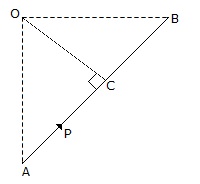
The moment of the force ‘P’ about ‘O’ as shown in the below figure is
A. P × OA
B. P × OB
C. P × OC
D. P × AC
Select an option to see the answer and solution.
The total momentum of a system of masses (i. e. moving bodies) in any one direction remains constant, unless acted upon by an external force in that direction. This statement is called
A. Newton's first law of motion
B. Newton's second law of motion
C. Principle of conservation of energy
D. Principle of conservation of momentum
Select an option to see the answer and solution.
The unit of force in S.I. system of units is
A. Dyne
B. Kilogram
C. Newton
D. Watt
Select an option to see the answer and solution.
The Cartesian equation of trajectory is (where u = Velocity of projection, α
A. y = 2 u 2 cos 2 α g x 2 + x tan α
B. y = 2 u 2 cos 2 α g x 2 − x tan α
C. y = x tan α − 2 u 2 cos 2 α g x 2
D. y = x tan α + 2 u 2 cos 2 α g x 2
Select an option to see the answer and solution.
The velocity ratio of a first system of pulleys with 4 pulleys is
Select an option to see the answer and solution.
A body moves, from rest with a constant acceleration of 5 m per sec. The distance covered in 5 sec is most nearly
A. 38 m
B. 62.5 m
C. 96 m
D. 124 m
Select an option to see the answer and solution.
A body moves, from rest with a constant acceleration of 5 m per sec. The distance covered in 5 sec is most nearly
A. 38 m
B. 62.5 m
C. 96 m
D. 124 m
Select an option to see the answer and solution.
The angular velocity (in rad/s) of a body rotating at N revolutions per minute is
A. 60 π N
B. 180 π N
C. 60 2 π N
D. 180 2 π N
Select an option to see the answer and solution.
A cable with a uniformly distributed load per horizontal meter run will take the following shape
A. Straight line
B. Parabola
C. Hyperbola
D. Elliptical
Select an option to see the answer and solution.
The velocity ratio of a differential pulley block with D and d as the diameters of larger and smaller pulley, is
A. D − d D
B. D + d D
C. D − d 2 D
D. D + d 2 D
Select an option to see the answer and solution.
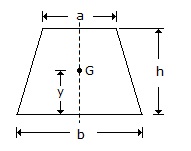
The center of gravity of a trapezium with parallel sides 'a' and 'b' lies at a distance of 'y' from the base 'b', as shown in the below figure. The value of 'y' is
A. h ( a + b 2 a + b )
B. 2 h ( a + b 2 a + b )
C. 3 h ( a + b 2 a + b )
D. 3 h ( 2 a + b a + b )
Select an option to see the answer and solution.
Which of the following statement is incorrect?
A. A force acting in the opposite direction to the motion of the body is called force of friction
B. The ratio of the limiting friction to the normal reaction is called coefficient of friction
C. A machine whose efficiency is 100% is known as an ideal machine
D. The velocity ratio of a machine is the ratio of load lifted to the effort applied
Select an option to see the answer and solution.
The length of a second's pendulum is
A. 94.9 cm
B. 99.4 cm
C. 100 cm
D. 101 cm
Select an option to see the answer and solution.
The moment of a force
A. Is the turning effect produced by a force, on the body, on which it acts
B. Is equal to the product of force acting on the body and the perpendicular distance of a point and the line of action of the force
C. Is equal to twice the area of the triangle, whose base is the line representing the force and whose vertex is the point, about which the moment is taken
D. All of the above
Select an option to see the answer and solution.
The motion of a wheel of a car is
A. Purely translation
B. Purely rotational
C. Combined translation and rotational
D. None of these
Select an option to see the answer and solution.
The rate of doing work is known as
A. Potential energy
B. Kinetic energy
C. Power
D. None of these
Select an option to see the answer and solution.