The oxidation reaction lines of metals/nonmetals parallel to x- axis in Ellingham diagram is corresponds to
A. Change in entropy zero
B. Change in enthalpy zero
C. Change in free energy zero
D. Change in temperature zero
Select an option to see the answer and solution.
What is the temperature range for CO where it can act as reducing agent for iron oxide reduction
A. Less than 1000°C
B. More than 1000°C
C. Does not depends on temperature
D. None of these
Select an option to see the answer and solution.
The activity of pure hydrogen gas at 1000°C and 5 atm. pressure.
A. is always less than 1
B. is always greater than 1
C. can be 5
D. depends on the choice of the standard state
Select an option to see the answer and solution.
If two system P & Q are in thermal equi librium with a third system M, then P and Q will also be in thermal equilibrium with each other. This is following . . . . . . . . law of thermodynamics.
A. first
B. second
C. third
D. zeroth
Select an option to see the answer and solution.
As the temperature increases, the solubility of gas in molten metal . . . . . . . . at constant pressure
A. increase
B. decrease
C. remain constant
D. none of these
Select an option to see the answer and solution.
A chemical reaction whose rate does not depend on concentration of reactants is called
A. Zero order reaction
B. first order reaction
C. second order reaction
D. third order reaction
Select an option to see the answer and solution.
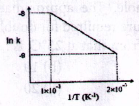
If k is the rate constant for a reaction and T is the absolute temperature in the given figure, the activation energy for the reaction is . . . . . . . . J/K mole.
Select an option to see the answer and solution.
The erder of a chemical reaction
A. can be determined only expedrimentally
B. can be determined from the stoichiometry of the reaction
C. can not be zero
D. can be fractional
Select an option to see the answer and solution.
In reaction equilibria occuring between pure condensed phases and a gas phase, the equilibrium constant, K
A. can be written solely in terms of those species which occur only in the gas phase
B. is always independent of the species that occur in the gas phase
C. can be written solely in terms of those species which occur only in the pure condensed phases
D. depends only on the concentration of pure species present in the mixture of condensed phases
Select an option to see the answer and solution.
When one mole of the substance is completely burnt in oxygen. The heat evolve is known
A. Heat of combustion
B. Heat of reaction
C. Heat of formation
D. None of these
Select an option to see the answer and solution.
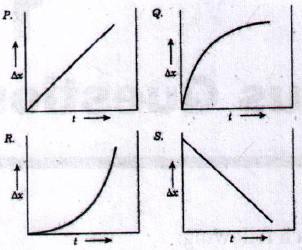
If 'Δx' represents adherent oxide layer thickness and 't' is time, which of the following curves represents diffusion controlled oxidation kinetics?
Select an option to see the answer and solution.
The reduction of FeO with CO gas in co-current flow is given by the following equation:2 , ΔG° = 8120 J at 1173K The ratio of pco/pco2 for this reaction at 1173K is
Select an option to see the answer and solution.
Zinc oxide is reduced at a constant temperature in a closed reactor using ZnO(s) and C(s) as the only starting materials. The following reactions are assumed to be at thermodynamic equilibrium:2 (g) + C(s)
A. Pzn = Pco + 2Pco2
B. Pzn = 2pco + Pco2
C. Pzn = pco + Pco2
D. Pzn = 0.5 Pco + 2Pco2
Select an option to see the answer and solution.
For the irreversible reaction, Ca + C = CaC2 , ΔH°298 = - 60,000 J.mol-1 . If a system, initially containing 2 moles of calcium, 3 moles of carbon and one mole of calcium carbide, is allowed to react to completion, the heat evolved, at 298 K will be . . . . . . . . J.
A. 30,000
B. 60,000
C. 90,000
D. 240,000
Select an option to see the answer and solution.
The half-life period for second order reactions is given as
A. t 2 1 = 2 K [ A 0 ]
B. t 2 1 = K 0.693
C. t 2 1 = K [ A 0 ] 1
D. t 2 1 = 2 K [ A 0 ] 2 3
Select an option to see the answer and solution.
The expression for first law of thermodynamics
A. dU = δq - δW
B. dU = δP - δW
C. dU = δP + δW
D. dQ = δU - δW
Select an option to see the answer and solution.
The effect of change in temperature on the entropy of formation of an ideal binary solution, ΔSM, id , is such that ΔSM, id
A. increases with temperature
B. decreases with temperature
C. is always zero
D. is independent of temperature
Select an option to see the answer and solution.
At absolute zero temperature, for any reaction involving condensed phases
A. ΔG° = 0, ΔH° = 0
B. ΔH° = 0, ΔS° = 0
C. ΔS° = 0, ΔE° = 0
D. ΔS° = 0, ΔCP ° = 0
Select an option to see the answer and solution.
In a binary system, the difference in chemical potentials of two components (μi - μj) is equal to
A. d x j d G m
B. 0
C. ( 1 − x j ) d x j d G m
D. − d x j d G m
Select an option to see the answer and solution.
One mole of element P is mixed with one mole of element Q. The entropy of jnixing at 0°K is
A. 0
B. - R In 0.5
C. infinity
D. - R In 2
Select an option to see the answer and solution.