A plastically deformed metal crystal at low temperature exhibits wavy slip line pattern due to
A. Dislocation pile-up
B. Large number of slip systems
C. Low stacking faultenergy
D. Dislocation climb
Select an option to see the answer and solution.
Which of the following microstructures of the eutectic is not observed in binary alloys?
A. Lamellar
B. Widmanstatten
C. Acicular
D. Nodular
Select an option to see the answer and solution.
Upon addition of sodium oxide to molten silicate slag, the viscosity of the slag
A. decreases because the oxygen ions supplied by the sodium oxide break the chain structure of the silicate slag
B. increases because the oxygen ion supplied by the sodium oxide further add to the oxygen network in the slag
C. remains unaffected because fundamentally one can not distinguish between the oxygen ions supplied by the sodium oxide and those already present in the slag
D. remains unaffected because the oxygen ions fill up the holes and vacancies present in the liquid slag
Select an option to see the answer and solution.
A 0.4 wt% C steel is austenitised at 900°C for 1 hour and heat treated to get different. inicrostructures. Match the following microstructures to the heat treatments.
P. Martensite + Retained austenite
1. Annealing
Q. Ferrite + fine pearlite
2. Quenching
R. Ferrite + spheroidal cementite
3. Quenching + temperature at 600°C
S. Ferrite + coarse pearlite
4. Normalising
A. P-4, Q-3, R-2, S-1
B. P-1, Q-2, R-3, S-4
C. P-2, Q-4, R-1, S-3
D. P-2, Q-4, R-3, S-1
Select an option to see the answer and solution.
Which of the following has the highest hardness number?
A. Martensite
B. Tempered martensite
C. Pearlite
D. Fine pearlite
Select an option to see the answer and solution.
Assertion: a : During hardening of steel, the component to be heat treated is strongly agitated in the quenching medium.Reason : r : The agitation breaks down the vapour barrier allowing the quench to proceed at a more rapid rate.
A. Both 'a' and 'r' are correct but 'r' is not correct reason of 'a'
B. Both 'a' and 'r' are false
C. 'a' is true but 'r' is false
D. Both 'a' and 'r' are correct and 'r' is the correct reason for 'a'
Select an option to see the answer and solution.
Stretcher strains found in a low carbon sheet are associated with
A. texture
B. dislocation density
C. yield point phenomenon
D. thickness of the sheet
Select an option to see the answer and solution.
Identify the type of the following invariant reaction:
A. Eutectic
B. Eutectoid
C. Peritectic
D. Peritectoid
Select an option to see the answer and solution.
With increase in annealing temperature, the following defect density decreases.
A. Vacancy
B. Dislocation
C. Grain boundary
D. All of them
Select an option to see the answer and solution.
The number of Bravais space lattices with two lattice points are
Select an option to see the answer and solution.
Malleabilisation heat treatment is performed on
A. cast steel
B. gray cast iron
C. white cast iron
D. spheroidal graphite cast iron
Select an option to see the answer and solution.
What are the crystal structure of Cu, AI, Si, Zn and Ge?
A. FCC, FCC, DC, HCP, DC
B. FCC, FCC, BCC, HCP, BCC
C. FCC, FCC, DC, BCT, DC
D. FCC, FCC, BCC, HCP, DC
Select an option to see the answer and solution.
Match the basic strengthening mechanisms in the following materials.
Group-I Group-II
P. 60 : 40 brass is stronger than 70 : 30 brass.
1. Case hardening
Q. An automobile gear made from 0.6% C steel and quenched in water from a temperature of 850°C.
2. Strain hardening
R. Tungsten filament drawn at a temperature of 400°C.
3. Martensitic strengthening
S. A ball bearing heated in furnace in ammonia atmosphere.
4. Second phase strengthening
A. P-4, Q-3, R-2, S-1
B. P-1, Q-2, R-3, S-4
C. P-4, Q-3, R-1, S-2
D. P-3, Q-4, R-2, S-1
Select an option to see the answer and solution.
In a dilute solid solution of nickel and carbon in y-iron.
A. Dc > DNI
B. Dc < DNI
C. Dc > DFe
D. Dc = DNI
Select an option to see the answer and solution.
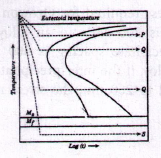
Match the heat treatment for an eutectoid steel shown in the TTT diagram below (as P, Q, R and S) with the resulting microstructure listed below:
1. Fine pearlite
2. martensite
3. Bainite
4. Coarse pearlite
A. P-1, Q-2, R-4, S-3
B. P-4, Q-1, R-3, S-2
C. P-2, Q-1, R-3, S-4
D. P-1, Q-4, R-3. S-2
Select an option to see the answer and solution.
Match the phenomena listed in
Group I with the possible mechanisms in
Group II .
Group I Group II
P. Fatigue
1. Grain boundary sliding
Q. Creep
2. Slip band extrusion and intrusion
R. Strain hardening
3. Cottrell atmosphere
S. Yield point phenomenon
4. Dislocation interaction
A. P-2, Q-3, R-4, S-1
B. P-2, Q-4, R-3, S-1
C. P-2, Q-1, R-4, S-3
D. P-1, Q-2, R-4, S-3
Select an option to see the answer and solution.
An Al 4.5 mass% Cu alloy solutionising at 500°C, quenched to room temperature and aged at 200°C for 2 hrs is found to exhibit an increase in hardness. Theprimary mechanism contributing to increased hardness is
A. martensitic transformation due to quenching
B. solid solution strengthening
C. precipitation hardening
D. point defect strengthening
Select an option to see the answer and solution.
The low angle grain boundary occurs when the orientation difference between the adjacent grains is of the order of
A. 100°
B. 10°
C. 1
D. none of these
Select an option to see the answer and solution.
An Fe - 3 wt % C - 1 wt % Si alloy is cooled very slowly from the liquid state to a temperature of 1023 K. Thereafter, it is cooled in air. The microstructure at room temperature will consist of
A. ferrite + graphite
B. pearlite + graphite
C. martensite + graphite
D. ferrite + pearlite
Select an option to see the answer and solution.
An annealed plain carbon steel, showing fully pearlitic microstructure, has a carbon content of . . . . . . . . wt%.
Select an option to see the answer and solution.