Vidyalelo
Metallurgical Engineering · all questions

Physical Metallurgy
practice.

Practice every MCQ with options. Use Show answers when you want the correct option and solution.

162

Questions

4/9

Page

Pick an option on a question to see the right answer and solution.

Dislocation cross-slip is difficult in those materials which have

Select an option to see the answer and solution.

The number of components is 2, the number of phases are 3 and degrees of freedom are 0. Then which of the following equilibrium is it?

Select an option to see the answer and solution.

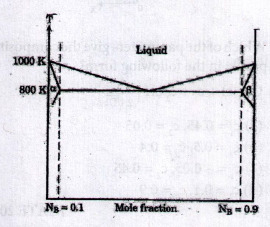
In the hypothetical phase diagram, the melting point of each pure component is. 1000 K and the eutectic temperature is 800 K. The eutectic is located at the equi-atomic composition. The maximum solid solubility in α-phase is given by the mole fraction, Ne = 0.1.
The freezing range (in K) of the alloy with composition, Ne = 0.1 is
Physical Metallurgy mcq question image

Select an option to see the answer and solution.

With the increase in the degree of supercooling, the growth rate of a nucleus follows which one of the following trends?

Select an option to see the answer and solution.

Match the heat treatment process in Group I with resultant microstructure Group II.
Group I Group II
P. Martempering 1. Coarse pearlite
Q. Normalising 2. Fine pearlite
R. Sub-critical annealing for long time 3. Tempered martensite
S. Full annealing 4. Spheroidised cementite in the matrix of ferrite

Select an option to see the answer and solution.

Match the items in Group1 with those in Group2.
Group 1 Group 2
P. Fatigue 1. Cracking at extrusions and intrusions
Q. Hall-petch equation 2. Dislocation pile up
R. Creep 3. Slip and twinning
S. Plastic deformation 4. Grain boundary sliding
5. Angle of grain boundary
6. Young's modulus

Select an option to see the answer and solution.

Determine the correctness or otherwise of the following Assertion (a) and Reason (r).
Assertion (a): Peak aging time for an Al-4 wt.% Cu alloy is indicated by a maximum in the hardness.
Reason (r): The maximum volume fraction of the θ precipitates is formed at the peak aging time.

Select an option to see the answer and solution.

The stress required for Orowon dislocation bypass is 200 MPa in an alloy when the interprecipitate spacing is 500 nm. In the same alloy, if the inter-precipitate spacing is reduced to 200 nm, the stress required (in MPa) is

Select an option to see the answer and solution.

The self diffusion in FCC metals occurs by one of the following mechanisms.

Select an option to see the answer and solution.

A binary alloy system A-B shows the peritectic reaction, L + α (⟶β). An alloy of the peritectic composition when cooled under natural cooling conditions will show coring in

Select an option to see the answer and solution.

It is possible to form martensite

Select an option to see the answer and solution.

The following reactions are written such that the forward reaction occurs during cooling. Match the reactions to their names.
Group-I Group-II
P. Y = α + β 1. peritectoid
Q. L+ α = β 2. Eutectoid
R. L1 = L2 + α 3. Peritectic
S. α + β = Y 4. Monotectic

Select an option to see the answer and solution.

Match the associated primary change in Group 2 with the corresponding phenomenon in Group 1.
Group 1 Group 2
P. Recovery 1. change in dislocation density
Q. Recrystallisation 2. change in the shape of a phase
R. Malleabilising 3. change in vacancy concentration
S. Texture 4. change in grain orientation

Select an option to see the answer and solution.

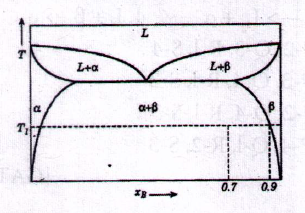
An alloy of overall composition, XB = 0.7 was equilibrated at temperature T1. Microstructural analysis showed two phases, (α and β, and that the phase fraction of β was 0.75. Given that the equilibrium composition of β at Ti is 0.9 as shown in the phase diagram below, the maximum solubility of B in α (in mole fraction) at this temperature is . . . . . . . .
Physical Metallurgy mcq question image

Select an option to see the answer and solution.

According to Griffith theory, which of the following are true for the fracture stress in a brittle material?
P. Increases with increasing surface energy
Q. Decreases with increasing elastic modulus
R. Decreases with increasing length of pre-existing crack
S. Decreases with increasing number of pre-existing cracks of same size

Select an option to see the answer and solution.

Match the following strengthening methods (Group I) in metallic alloys with typical mechanisms responsible (Group II) for them.
Group I Group II
P. Grain size strengthening 1. Orowan looping
Q. Work hardening 2. Suzuki interaction
R. Dispersion strengthening 3. Lomer-Cottrell-barrier
S. Solid solution hardening 4. Dislocation pile up at grain boundaries

Select an option to see the answer and solution.

Which one of the following can avoid weld decay of austenitic stainless steels?

Select an option to see the answer and solution.

Lath martensitic microstructure we can see in

Select an option to see the answer and solution.

Regarding recrystalisation, which one of the following statements is not correct?

Select an option to see the answer and solution.

In age hardenable alloys maximum ductility is obtained

Select an option to see the answer and solution.