Ceteris paribus, a change in the price of a commodity causes the quantity purchased of its complements to move
A. In an insignificant manner
B. In the opposite direction
C. In the same direction
D. Cannot be known
Select an option to see the answer and solution.
"The price which is necessary to retain a given unit of a factor in a certain industry may be called its transfer earnings or transfer price." Defined by
A. Prof. Lipsey
B. Alfred Marshall
C. Robertson
D. Joan Robinson
Select an option to see the answer and solution.
In the income, distributed method for finding out national income, which one is not considered as factor income?
A. Labour income
B. Private income
C. Capital income
D. Mixed or other income
Select an option to see the answer and solution.
Which of the following are not the assumptions related to the theory of consumer behaviour as per the cardinal utility approach?
A. 1, 3, 5 and 7
B. 2, 4 and 5
C. 1, 3, 4 and 5
D. Both 6 and 7
Select an option to see the answer and solution.
Which statement(s) is/are correct?
A. In case of elastic demand, total revenue declines with price increase
B. In case of unitary elastic demand, total revenue is unaffected by change in price
C. In inelastic demand, total revenue rised with price increase
D. All of the above
Select an option to see the answer and solution.
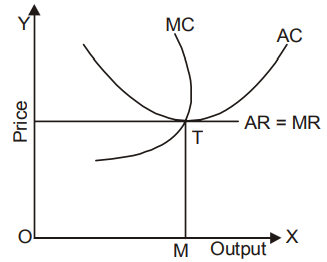
In the following wing diagram of a competitive firm, T point includes
A. No profit
B. Abnormal profit
C. Normal profit
D. Heavy loss
Select an option to see the answer and solution.
A perfectly competitive industry becomes a monopoly with the same cost conditions, it will now sell
A. A larger output at a higher price
B. A larger output at the old price
C. An unchanged output at a higher price
D. A reduced output at a higher price
Select an option to see the answer and solution.
Take it or leave it' price discrimination is of
A. third degree
B. second degree
C. first degree
D. zero degree
Select an option to see the answer and solution.
The lowest point of the TC curve is
A. The same as the lowest point of AVC curve
B. The right of the lowest point of the AVC curve
C. The left of the lowest point of the AVC curve
D. None of these
Select an option to see the answer and solution.
MU of nth unit is found by the following formula
A. TU.n
B. n TU
C. Tun - TU(n - 1)
D. TU = +n
Select an option to see the answer and solution.
In the short run analysis, MP = 0 at the level in which
A. Marginal product is maximum
B. Total profit is maximum
C. Total product is maximum
D. Average product is maximum
Select an option to see the answer and solution.
Which is the correct statement about GNP?
A. GNP at factor cost = GNP at MP - Indirect taxes + subsidies
B. GNP at market price = GDP + Cost of capital
C. GNP = Capital + Assets - Depreciation
D. GNP = Wages + Dividends
Select an option to see the answer and solution.
Under perfect competition a firm can produce with
A. An optimum plant
B. Identical products at low cost
C. Maximum profit
D. An optimum output
Select an option to see the answer and solution.
Which of the following is the correct statement?M P y M P x
A. 2, 3 and 4
B. 1, 3 and 4
C. 1, 2, 3 and 4
D. 1, 2 and 3
Select an option to see the answer and solution.
In short run, the law of variable proportions is also known as the
A. Law of constant returns
B. Law of diminishing returns
C. Law of increasing returns
D. Law of return to scale
Select an option to see the answer and solution.
Lerner's index of monopoly power is
A. P P − M C
B. e 1
C. Both A and B
D. None of these
Select an option to see the answer and solution.
If the GNP is Rs. 550 crore and NNP is Rs. 475 crore, the depreciation is
A. Rs. 100 crore
B. Rs. 75 crore
C. Rs. 175 crore
D. cannot be calculated
Select an option to see the answer and solution.
Who proposed the degrees of price discrimination?
A. Professor A. C. Pigon
B. Professor Lerner
C. Alfred Marshall
D. Wicksell and Cairnes
Select an option to see the answer and solution.
When all the productive services are increased in a given proportion, the product is increased in the same proportion. This situ ation is called
A. Variable cost
B. Situation of Constant Returns
C. Fixed cost
D. Law of Increasing Returns
Select an option to see the answer and solution.
The indifference curve which is 'L' shaped represents
A. Perfect complementarity
B. Perfect substitutability
C. No substitutability
D. Non complementarity
Select an option to see the answer and solution.