Ordinal approach is based on
A. Utility could not be measured in ordinal numbers
B. Utility could not be measured in cardinal numbers
C. Law of maximum satisfaction
D. Utility can be measured
Select an option to see the answer and solution.
If the individual firm's demand curve is coincident with the market demand curve then
A. Marginal revenue is equal to average revenue
B. The firm is a monopolist
C. The firm can set any price it wants without limitation
D. The firm is price-taker
Select an option to see the answer and solution.
Match the following:
List-I (Items) List-II (Applications)
a. Profit
1. Sales - (VC + FC)
b. Margin of safety
2. Sales − VC FC + Profit
c. Sales in Rs.
3. 1 − Sales VC FC + Profit
d. Contribution margin per unit
4. BEP in units Fixed Cost
5. Profit + TFC
A. a-1, b-2, c-3, d-4
B. a-1, b-5, c-2, d-4
C. a-3, b-1, c-2, d-4
D. a-3, b-4, c-2, d-1
Select an option to see the answer and solution.
Constrained optimization techniques are not designed to deal with the problem of
A. limited availability of essential inputs
B. self-serving management
C. contractual requirements
D. scarce investment funds
Select an option to see the answer and solution.
Which statement is/are true?
A. If demand is elastic, a price increase will lower total revenue, and a decrease in price will raise total revenue
B. If demand is elastic, the relative change in quantity is larger than that of price, so a given percentage increase in price causes quantity to decrease by a larger percentage, decreasing total revenue
C. If demand is inelastic, a price increase will produce a less than proportionate decline in the quantity demanded
D. All of the above
Select an option to see the answer and solution.
From the following determinants of the price elasticity of demand, indicate the correct option for the determinants having a positive relationship with the degree of the price elasticity of demand.
A. Both 1 and 2
B. Both 3 and 4
C. 1, 2 and 3
D. 2, 3 and 4
Select an option to see the answer and solution.
The degree of price elasticity of demand used for goods is influenced by whether
A. 1, 3 and 4 only
B. 2 and 3 only
C. 1 and 2 only
D. 2, 3 and 4 only
Select an option to see the answer and solution.
On an indifference map, if the income consumption curve slopes downwards to the right it shows that
A. Both X and Y are superior goods
B. Y is an inferior good
C. X is an inferior good
D. Both X and Y are inferior goods
Select an option to see the answer and solution.
A consumer will be maximising his utility if he allocated his money income so that
A. Elasticity of demand is the same for all purchased products
B. The marginal utility from the last rupee spent on each purchased product is the same
C. The marginal utility of the last unit of each product consumed is equal
D. Total utility gained from each product consumed is the same
Select an option to see the answer and solution.
The substitution effect works to encourage a consumer to purchase more of a product when the price of that goods is falling because
A. Other products are now less expensive than before
B. The consumer's real income has de creased
C. The product is now relatively less expensive than before
D. The consumer's real income has increased
Select an option to see the answer and solution.
Match the following.
List-I List-II
a. Increasing cost industry
1. Negatively sloped long run supply curve
b. Decreasing cost industry
2. Positively sloped long run supply curve
c. Constant cost industry
3. Horizontal long run supply curve
A. a-3, b-1, c-2
B. a-3, b-2, c-1
C. a-2, b-3, c-1
D. a-2, b-1, c-3
Select an option to see the answer and solution.
The market share data for an industry, comprising five companies, is given below.
Company Market Share (%)
A
35
B
25
C
18
D
12
E
10
This industry's three-firms Herfindahl-Hirschman index shall be
A. 0.234
B. 0.217
C. 0.151
D. 0.0175
Select an option to see the answer and solution.
"Production" may be defined as an act of
A. Creating utility
B. Destroying utility
C. Earning profit
D. Providing services
Select an option to see the answer and solution.
Risk neutrality implies a
A. constant utility of income
B. constant marginal utility of income
C. diminishing marginal utility of income
D. increasing marginal utility of income
Select an option to see the answer and solution.
Other things being equal, a decrease in the quantity supplied to the market at given prices leads to
A. A higher price and a contraction of demand
B. A lower price and a contraction of demand
C. A higher price and an expansion of demand
D. A lower price and an expansion of demand
Select an option to see the answer and solution.
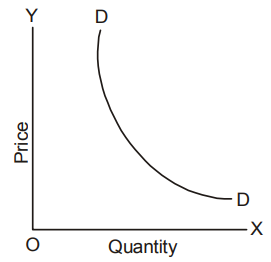
Given:
The above curve is a:
A. Demand curve
B. Product curve
C. Price curve
D. Profit curve
Select an option to see the answer and solution.
In all forms of imperfect competition the average revenue curve facing the individual slopes
A. Horizontally
B. Downward
C. Upward
D. Vertically
Select an option to see the answer and solution.
In perfect competition, there is a process of
A. Restricted entry and exit of the firms
B. Free entry and free exit of the firms
C. Free entry but restricted exit of the firms
D. Semi-free exit but absolute free entry
Select an option to see the answer and solution.
"Steps downwards at first and then upwards". It is the movement of
A. TFC curve
B. AVC curve
C. TVC curve
D. TC curve
Select an option to see the answer and solution.
A company supplies 20 units of a particular product per month, at a price of Rs. 10 per unit. If price elasticity of supply is 5, how many units would the company supply at a price of Rs. 15?
Select an option to see the answer and solution.