Consider a message signal whose spectrum is given by M(f)=1−104∣f∣,∣f∣⩽104 and zero elsewhere. The message signal amplitude modulates a carrier fc = 1 MHz. The bandwidth of the modulated signal is:
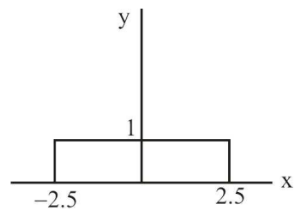
A uniformly distributed random variable X with probability density function fx(x)=101(u(x+5)−u(x−5))
Where u(⋅) is the unit step function is passed through a transformation given in the figure below. The probability density function of the transformed random variable Y would be
Consider the following statements regarding signals:
1. Deterministic signal is a signal about which there is no uncertainty with respect to its value at any time.
2. Each signal within the ensemble has a certain probability of occurrence and the ensemble of signals is referred to as a random process.
3. EEG signal is an example of random signal.
Which of the above statements are correct?
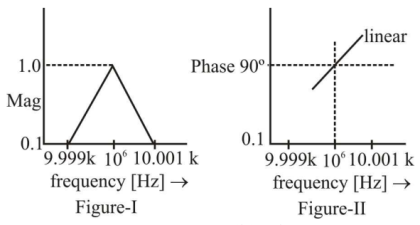
A carrier of frequency 1 MHz is amplitude modulated by a signal of frequency 1 kHz to a depth of 60%. This is passed through a filter of characteristics shown in the given Figure-I and Figure-II. If the filter output is fed to an envelope detector, the detector output will be
The RF amplifier A is having 3 dB NF & 5 dB of gain, amplifier B is having 3.5 dB NF & 15 dB. For overall noise figure of the cascaded system, the correct statement is: