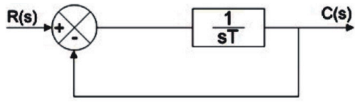
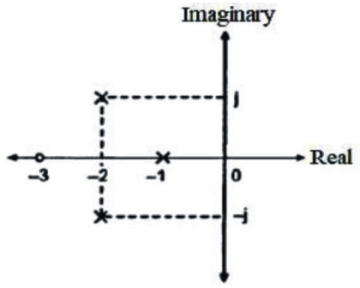
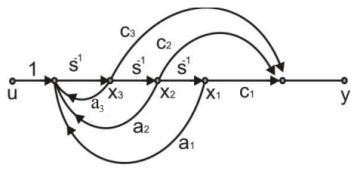
In the case of a second order system described by the differential equation, dt2Jd2θ0+Fdtdθ0+kθ0=kθi
(where θ1 and θ0 are input and output shaft angles), the natural frequency is given by:
Consider the following for a variable reluctance stepper motor used in system:
1. The stator torque acting on the rotor is a function of angular misalignment between stator and rotor teeth.
2. There are two positions of zero torque: θ=0∘,T180∘ (T = number of rotor teeth)
3. Both the torque zero positions are stable.
4. As the stator is excited, the rotor is pulled into the nearest minimum reluctance position.
Of these statements
Consider the following statements:
The Gain margin and Phase margin of an unstable system may respectively be:
1. Positive, negative
2. Negative, positive
3. Negative, negative
Which of the above statements is/are correct?
A system's open loop transfer function is given by G(s)=s(s+2)(s+4)K. If system is having a unity negative feedback, which of the following is true for such system to be stable?
The system represented by the state variable model \mathop X\limits^. = \left[ {\begin{array}{*{20}{c}}
0&{ - 1}\\
1&{ - 2}
\end{array}} \right]X + \left[ \begin{array}{l}
1\\
2
\end{array} \right]U is:
The loop transfer function of an LTI system is G(s)H(s)=s(s+2)(s+3)K(s+1)(s+5). For K > 0, the point on the real axis final DOES NOT belong to the root locus of the system is
A plant transfer function is given as G(s)=(KP+sKI)(s(s+2)1). When the plant operates in a unity feedback configuration, the condition for the stability of the closed loop system is
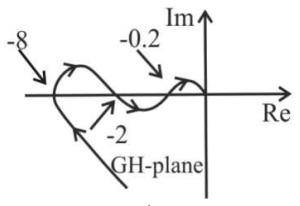
The polar diagram of conditionally stable system for open loop gain k = 1 is shown in the figure. The open loop transfer function of the system is known to be stable. The closed loop system is stable for