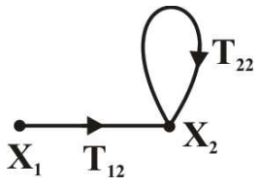
From the figure shown below, the Transfer function of the signal flow graph is:
A. 1 − T 22 T 12
B. 1 − T 12 T 22
C. 1 + T 22 T 12
D. 1 + T 12 T 22
Select an option to see the answer and solution.
In a closed loop system for which the output is the speed of a motor, the output rate control can be used to:
A. Limit the speed of the motor
B. Limit the torque output of the motor
C. Reduce the damping of the system
D. Limit the acceleration of the motor
Select an option to see the answer and solution.
The following quantities give a measure of the transient characteristics of a control system, when subjected to unit step excitation:
A. 1, 3 and 5
B. 2, 4 and 5
C. 2, 4 and 6
D. 1, 4 and 5
Select an option to see the answer and solution.
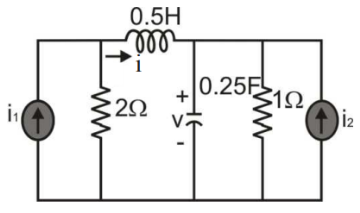
For the given circuit, which one of the following is the correct state equation?
A. \frac{d}{{dt}}\left[ \begin{array}{l}
v\\
i
\end{array} \right] = \left[ {\begin{array}{*{20}{c}}
{ - 4}&4\\
{ - 2}&{ - 4}
\end{array}} \right]\left[ \begin{array}{l}
v\\
i
\end{array} \right] + \left[ {\begin{array}{*{20}{c}}
0&4\\
4&0
\end{array}} \right]\left[ \begin{array}{l}
{i_1}\\
{i_2}
\end{array} \right]
B. \frac{d}{{dt}}\left[ \begin{array}{l}
v\\
i
\end{array} \right] = \left[ {\begin{array}{*{20}{c}}
{ - 4}&{ - 4}\\
{ - 2}&{ - 4}
\end{array}} \right]\left[ \begin{array}{l}
v\\
i
\end{array} \right] + \left[ {\begin{array}{*{20}{c}}
4&0\\
0&4
\end{array}} \right]\left[ \begin{array}{l}
{i_1}\\
{i_2}
\end{array} \right]
C. \frac{d}{{dt}}\left[ \begin{array}{l}
v\\
i
\end{array} \right] = \left[ {\begin{array}{*{20}{c}}
{ - 4}&{ - 4}\\
{ - 2}&4
\end{array}} \right]\left[ \begin{array}{l}
v\\
i
\end{array} \right] + \left[ {\begin{array}{*{20}{c}}
4&4\\
4&0
\end{array}} \right]\left[ \begin{array}{l}
{i_1}\\
{i_2}
\end{array} \right]
D. \frac{d}{{dt}}\left[ \begin{array}{l}
v\\
i
\end{array} \right] = \left[ {\begin{array}{*{20}{c}}
4&{ - 4}\\
{ - 2}&{ - 4}
\end{array}} \right]\left[ \begin{array}{l}
v\\
i
\end{array} \right] + \left[ {\begin{array}{*{20}{c}}
0&4\\
4&4
\end{array}} \right]\left[ \begin{array}{l}
{i_1}\\
{i_2}
\end{array} \right]
Select an option to see the answer and solution.
What is the value of K for a unity feedback system with G ( s ) = s ( 1 + s ) K
Select an option to see the answer and solution.
Which of the following components can be used as a rotating amplifier in a control system?
A. 3 and 4
B. 1 and 2
C. 1, 2 and 3
D. 1, 2, 3 and 4
Select an option to see the answer and solution.
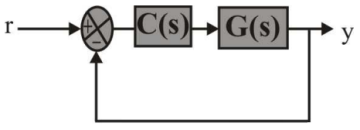
For the following feedback system
G ( s ) = ( s + 1 ) ( s + 2 ) 1 . The 2% settling time of the step response is required to be less than 2 seconds.
Which one of the following compensators C(s) achieves this?
A. 3 ( s + 5 1 )
B. 5 ( s 0.03 + 1 )
C. 2 ( s + 4 )
D. 4 ( s + 3 s + 8 )
Select an option to see the answer and solution.
The main purpose of feedback in a control system is
A. To have a reduced time constant
B. To make the system more stable
C. To decrease the response error
D. Sensitivity of the system is increased
Select an option to see the answer and solution.
In control systems, we have
A. 1 and 2 only
B. 2 and 4 only
C. 1 and 3 only
D. 3 and 4 only
Select an option to see the answer and solution.
In a feedback control system, phase margin (PM) is:
A. 1 and 2
B. 2 and 3
C. 3 and 4
D. 1 and 4
Select an option to see the answer and solution.
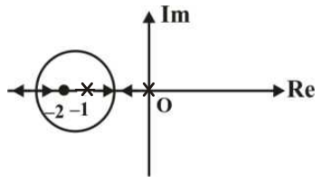
The below figure shows the root locus of a unity feedback system. The open loop transfer function of the system is:
A. s ( s + 1 ) ( s + 2 ) K
B. ( s + 1 ) ( s + 2 ) K s
C. s ( s + 2 ) K ( s + 1 )
D. s ( s + 1 ) K ( s + 2 )
Select an option to see the answer and solution.
In case of synchro error detector, the electrical zero position of control transformer is obtained when angular displacement between rotors is:
Select an option to see the answer and solution.
Separation property of state-transition matrix is:
A. φ(t - t0 ) = φ(t) φ(t0 )
B. φ(t - t0 ) = φ-1 (t) φ(t0 )
C. φ(t - t0 ) = φ(t) φ-1 (t0 )
D. φ(t - t0 ) = φ-1 (t) φ-1 (t0 )
Select an option to see the answer and solution.
Given A = \left[ {\begin{array}{*{20}{c}}
1&0\\
0&1
\end{array}} \right] the state transition matrix eAt is given by
A. \left[ {\begin{array}{*{20}{c}}
0&{{e^{ - t}}}\\
{{e^{ - t}}}&0
\end{array}} \right]
B. \left[ {\begin{array}{*{20}{c}}
{{e^t}}&0\\
0&{{e^t}}
\end{array}} \right]
C. \left[ {\begin{array}{*{20}{c}}
{{e^{ - t}}}&0\\
0&{{e^{ - t}}}
\end{array}} \right]
D. \left[ {\begin{array}{*{20}{c}}
0&{{e^t}}\\
{{e^t}}&0
\end{array}} \right]
Select an option to see the answer and solution.
A first order instrument is characterised by
A. Time constant only
B. Static sensitivity and time constant
C. Static sensitivity only
D. Damping coefficient and static sensitivity
Select an option to see the answer and solution.
Two identical first order systems have been cascaded non-interactively. The unit step response of the system will be
A. Over-damped
B. Under-damped
C. Undamped
D. Critically damped
Select an option to see the answer and solution.
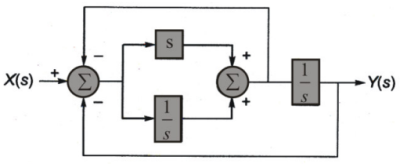
The block diagram of a system is illustrated in the figure shown, where X(s) is the input Y(s) is the output. The transfer function
H ( s ) = X ( s ) Y ( s ) is
A. H ( s ) = 2 s 2 + 1 s 2 + 1
B. H ( s ) = s 3 + 2 s 2 + s + 1 s 2 + 1
C. H ( s ) = s 2 + s + 1 s + 1
D. H ( s ) = s 3 + s 2 + s + 1 s 2 + 1
Select an option to see the answer and solution.
What is the unit step response of a unity feedback control system having forward path transfer function G ( s ) = s ( s + 18 ) 80 ?
A. Overdamped
B. Critically damped
C. Underdamped
D. Undamped oscillatory
Select an option to see the answer and solution.
Consider the following statements regarding time response specifications:
A. 1 and 2 only
B. 1 and 3 only
C. 2 and 3 only
D. 1, 2 and 3
Select an option to see the answer and solution.
A unit step input is applied to the negative feedback system whose closed loop transfer function is s 2 + 4.8 s + 9 63 ,
Select an option to see the answer and solution.