In Routh's-Hurwitz criterion, if there are changes of signs in the elements of the first column, then the number of sign changes indicates
A. The number of roots with negative real parts
B. The number of roots with positive real parts
C. The number of pair of roots of opposite sign
D. The number of pair of roots of same sign
Select an option to see the answer and solution.
While forming Routh's array, the situation of a row of zeros indicates that the system
A. Has symmetrically located roots
B. Is not sensitive to variation in gain
C. Is stable
D. Unstable
Select an option to see the answer and solution.
If the roots of the characteristic equation s2 + a1 s + a2 = 0 of a network are negative real and unequal, then the system is:
A. Oscillatory
B. Critically damped
C. Underdamped
D. Overdamped
Select an option to see the answer and solution.
What is represented by state transition matrix of a system?
A. Free response
B. Impulse response
C. Step response
D. Forced response
Select an option to see the answer and solution.
The bode plot is applicable to:
A. Minimum phase network
B. All phase network
C. Maximum phase network
D. None of the above
Select an option to see the answer and solution.
In the field-controlled motor, the entire damping comes from:
A. The armature resistance
B. The back emf
C. The motor friction and load
D. Field resistance
Select an option to see the answer and solution.
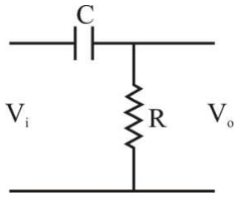
Phase of the transfer function of the following circuit is:
A. tan − 1 ( ω R C 1 )
B. tan − 1 ( ω R C )
C. tan − 1 ( ω R C )
D. tan − 1 ( R C ω )
Select an option to see the answer and solution.
The Bode plot of the transfer function G(s) = s is:2 π
A. 1 and 3
B. 1 and 4
C. 2 and 3
D. 2 and 4
Select an option to see the answer and solution.
What is the transfer function of a phase lead compensator? The values of β and τ are given as β < 1 and τ > 0.
A. ( β τ s + 1 ) β ( τ s + 1 )
B. ( τ s + 1 ) β ( β τ s + 1 )
C. ( τ s + 1 ) β ( β τ s − 1 )
D. ( τ s − 1 ) β ( β τ s − 1 )
Select an option to see the answer and solution.
For the system described by
X ⋅ = AX match
List-I with
List-II and select the correct answer.
List-I (Matrix A)List-II (Position of eigen values)
a. \left[ {\begin{array}{*{20}{c}}
{ - 1}&2\\
0&{ - 2}
\end{array}} \right]
1. One eigen value at the origin
b. \left[ {\begin{array}{*{20}{c}}
{ - 1}&{ - 2}\\
{ - 2}&{ - 4}
\end{array}} \right]
2. Both the eigen value in the LHP
c. \left[ {\begin{array}{*{20}{c}}
0&{ - 1}\\
1&0
\end{array}} \right]
3. Both the eigen values in RHP
d. \left[ {\begin{array}{*{20}{c}}
1&0\\
2&4
\end{array}} \right]
4. Both the eigen values on the imaginary axis
A. a-2, b-1, c-3, d-4
B. a-2, b-1, c-4, d-3
C. a-1, b-2, c-4, d-3
D. a-1, b-2, c-3, d-4
Select an option to see the answer and solution.
The Nyquist plot of: G ( s ) . H ( s ) = s 2 ( 1 + 0.5 s ) . ( 1 + s ) 10
A. will start (ω = ∞) in the first quadrant and will terminate (ω = 0) in the second quadrant
B. will start (ω = ∞) in the fourth quadrant and will terminate (ω = 0) in the second quadrant
C. will start (ω = ∞) in the second quadrant and will terminate (ω = 0) in the third quadrant
D. will start (ω = ∞) in the first quadrant and will terminate (ω = 0) in the fourth quadrant
Select an option to see the answer and solution.
A phase lead compensating network has its transfer function G C ( s ) = ( 1 + 0.01 s ) 10 ( 1 + 0.04 s ) .
A. 50 rad/s
B. 25 rad/s
C. 10 rad/s
D. 4 rad/s
Select an option to see the answer and solution.
Which one of the following compensation is adopted for improving transient response of a negative unity feedback system?
A. Phase lead compensation
B. Phase lag compensation
C. Gain compensation
D. Both phase lag compensation and gain compensation
Select an option to see the answer and solution.
A liquid level controller linearly converts a displacement of 2 m to 3 m into 4-20 mA control signal. A relay serves as two position controller to open and close an inlet valve. Relay closes at 12 mA and opens at 10 mA. The hysteresis zone is:
A. 0.1 m
B. 0.125 m
C. 0.15 m
D. 0.2 m
Select an option to see the answer and solution.
Given the system transfer function G ( s ) = s ( s + 2 ) ( s + 8 ) K e − 0.2 s ,
A. 0.2, 0.6
B. 1, 4
C. 3, 7
D. 2, 8
Select an option to see the answer and solution.
A second order LTI system is described by the following state equationsdt d 1 (t) - x2 (t) = 0dt d 2 (t) + 2x1 (t) + 3x2 (t) = r(t)
where x1 (t) and x2 (t) are the two state variables and r(t) denotes the input. The output c(t) = x1 (t).
A. undamped (oscillatory)
B. underdamped
C. critically damped
D. overdamped
Select an option to see the answer and solution.
Where are the K = ±∞ points on the root loci of the characteristic equation of the closed loop control system located at?
A. Poles of G(s)H(s)
B. Zeroes of G(s)H(s)
C. Both Zeros and Poles of G(s)H(s)
D. Neither at Zeros nor at Poles of G(s)H(s)
Select an option to see the answer and solution.
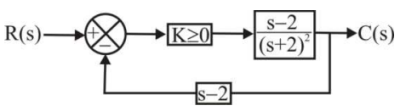
The feedback control system in the figure is stable.
A. for all K ≥ 0
B. only if K ≥ 0
C. only if 0 ≤ K < 1
D. only if 0 ≤ K ≤ 2
Select an option to see the answer and solution.
Consider the characteristic equation of a control system given by s3 + (K + 0.5)s2 + 4Ks + 50 = 0. Find the value of K for the system to have sustained oscillations.
Select an option to see the answer and solution.
The open-loop transfer function of a system is given by G ( s ) H ( s ) = s ( s + 10 ) 100 ( s + 100 ) .
A. 0 dB and 4 − 3 π
B. 0 dB and 4 π
C. 20 dB and 4 − 3 π
D. 20 dB and 4 π
Select an option to see the answer and solution.