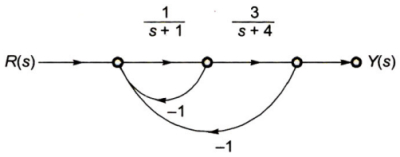
For the flow diagram shown in figure, the transfer function
R ( s ) Y ( s ) is
A. s 2 + 6 s + 11 3
B. s 2 + 5 s + 4 3
C. s 2 + 6 s + 8 3
D. s 2 + 6 s + 11 − 3
Select an option to see the answer and solution.
The basic element for a pneumatic controller is
A. Op-Amp
B. RC circuit
C. Flapper nozzle
D. None of these
Select an option to see the answer and solution.
A system described by the transfer function H ( s ) = s 3 + α s 2 + K s + 3 1
A. α > 0, αK < 3
B. α > 0, αK > 3
C. α < 0, αK > 3
D. α < 0, αK < 3
Select an option to see the answer and solution.
In force current analogy, electrical capacitance is analogous to:
A. Voltage
B. Force
C. Compliance
D. Mass
Select an option to see the answer and solution.
A motion control-system has type-2 plant. A recommended cascade compensation scheme for this system employs.
A. a lag compensator
B. a lead compensator
C. either a lag or lead compensator
D. neither a lag nor a lead compensator
Select an option to see the answer and solution.
The state space representation of a linear time invariant system is:
X .
A. C(sI - A)-1 B
B. B(sI - A)-1 C
C. C(sI - A)B
D. B(sI - A)C
Select an option to see the answer and solution.
A sensitivity of transfer function T = A 3 + k A 4 A 1 + k A 2
A. ( A 3 + k A 4 ) ( A 1 + k A 2 ) k ( A 2 A 3 − A 1 A 4 )
B. ( A 3 + k A 4 ) 2 ( A 2 A 3 − A 1 A 4 )
C. ( A 3 + k A 4 ) 2 k ( A 2 A 3 − A 1 A 4 )
D. ( A 3 + k A 4 ) ( A 1 + k A 2 ) ( A 2 A 3 − A 1 A 4 )
Select an option to see the answer and solution.
When a human being tries to approach an object, his brain acts as:
A. an error measuring device
B. a controller
C. an actuator
D. an amplifier
Select an option to see the answer and solution.
Two systems are defined by their state veritable equation in time domain dx(t)/dt = Ax(t) + Bu(t) as follows. If the gain equation in this are as given below, which of the following choices is correct?\begin{array}{l}
{\rm{A}} = \left[ {\begin{array}{*{20}{c}}
{ - 2}&1\\
0&{ - 1}
\end{array}} \right],\,{\rm{B}} = \left[ \begin{array}{l}
1\\
0
\end{array} \right]{\rm{. }}{\rm{. }}{\rm{. }}{\rm{. Equation 1}}\\
{\rm{A}} = \left[ {\begin{array}{*{20}{c}}
0&1\\
{ - 1}&0
\end{array}} \right],\,{\rm{B}} = \left[ \begin{array}{l}
0\\
1
\end{array} \right]{\rm{. }}{\rm{. }}{\rm{. }}{\rm{. Equation 2}}
\end{array}
A. Both Equations are uncontrollable
B. Both Equations are controllable
C. Only Equations 1 is controllable
D. Only Equations 2 is controllable
Select an option to see the answer and solution.
If there are sign changes in the first column of Routh's array, the system is
A. stable
B. unstable
C. unpredictable
D. unrealizable
Select an option to see the answer and solution.
The roots of the characteristic equation 1 + G(s) H(s) = 0 are the same as the
A. Poles of the closed loop transfer function
B. Poles of the open loop transfer function
C. Zeros of the closed loop transfer function
D. Zeros of the open loop transfer function
Select an option to see the answer and solution.
System transformation function H(z) for a discrete time LTI system expressed in state variable form with zero initial conditions is
A. c(zI - A)-1 b + d
B. c(zI - A)-1
C. (zI - A)-1 z
D. (zI - A)-1
Select an option to see the answer and solution.
The system matrix of a continuous time system is given by A = \left[ {\begin{array}{*{20}{c}}
0&1\\
{ - 3}&{ - 5}
\end{array}} \right]. Then the characteristic equation is
A. s2 + 5s + 3 = 0
B. s2 - 3s - 5 = 0
C. s2 + 3s + 5 = 0
D. s2 + s + 2 = 0
Select an option to see the answer and solution.
If both fast response time and good steady state accuracy are needed . . . . . . . . compensators are used.
A. Fast
B. Lead
C. Lag
D. Lag-lead
Select an option to see the answer and solution.
The open-loop transfer function of a unity feedback control system is G ( s ) = ( s + 2 ) 2 1
A. -2, -2
B. -2, -1
C. -2, +2
D. -2 ± j1
Select an option to see the answer and solution.
Match
List-I with
List-II and select the correct answer.
List-I (Functional components)List-II (Devices)
a. Error detector
1. Three-phase FHP induction motor
b. Servomotor
2. A pair of synchronous transmitter and control transformer
c. Amplifier
3. Tachogenerator
d. Feedback
4. Armature controlled FHP d.c. motor
5. Amplidyne
A. a-2, b-4, c-1, d-5
B. a-4, b-2, c-5, d-3
C. a-2, b-4, c-5, d-3
D. a-1, b-2, c-3, d-5
Select an option to see the answer and solution.
For continuous-time system, state variable representation is dt d
A. dt d
B. q[n + 1] = Aq[n] + bx[n]
C. q[n] = Aq[n - 1] + bx[n]
D. dn d
Select an option to see the answer and solution.
The system matrix of a continuous time system is described in the state variable form is:A = \left[ {\begin{array}{*{20}{c}}
x&0&0\\
0&y&{ - 1}\\
0&1&{ - 2}
\end{array}} \right]
A. x < 2 1 , y < 2 1
B. x > 2 1 , y > 0
C. x < 0 , y < 2
D. x < 0 , y < 2 1
Select an option to see the answer and solution.
Error constants of system are a measure of
A. Steady-state response
B. Transient-state respose
C. Relative stability
D. Steady-state as well as transient resporise
Select an option to see the answer and solution.
For proper working of a damper, the time constant should be
A. large
B. equal to signal time-period
C. zero
D. less than 5 times the signal time period
Select an option to see the answer and solution.