Consider the following statements with reference to frequency-domain approaches to analysis of feedback to control system
A. 1 and 2 only
B. 1 and 3 only
C. 2 and 3 only
D. 1, 2 and 3
Select an option to see the answer and solution.
The transfer function of a plant is T ( s ) = ( s + 5 ) ( s 2 + s + 1 ) 5 .
A. ( s + 5 ) ( s + 1 ) 1
B. ( s + 5 ) ( s + 1 ) 5
C. s 2 + s + 1 5
D. s 2 + s + 1 1
Select an option to see the answer and solution.
The correct sequences of steps needed to improve system stability is:
A. Insert derivative action, use negative feedback, reduce gain
B. Reduce gain, use negative feedback, insert derivative action
C. Reduce gain, Insert derivative action, use negative feed back
D. Use negative feedback, reduce gain, and insert derivative action
Select an option to see the answer and solution.
The phase-lead network function G C ( s ) = s + a T 1 s + T 1 ,
Select an option to see the answer and solution.
Identify the matrix that can be a state transition matrix.
A. \phi = \left[ {\begin{array}{*{20}{c}}
{{e^{ - t}}}&0\\
1&{{e^{ - 2t}}}
\end{array}} \right]
B. \phi = \left[ {\begin{array}{*{20}{c}}
{{e^t}}&t\\
1&{2{e^{ - t}}}
\end{array}} \right]
C. \phi = \left[ {\begin{array}{*{20}{c}}
{{e^t} + {e^{ - t}}}&0\\
0&{2{e^{ - t}}}
\end{array}} \right]
D. \phi = \left[ {\begin{array}{*{20}{c}}
{{e^{ - t}}}&0\\
0&{{e^{ - 2t}}}
\end{array}} \right]
Select an option to see the answer and solution.
Consider the following information regards open loop frequency response of a unity feedback system
ω |G(j)| ∠G(j)
2
7.5
-118°
3
4.8
-130°
4
3.15
-140°
5
2.25
-150°
6
1.70
-157°
8
1.00
-170°
10
0.64
-180°
The gain and phase margin of the system are respectively:
A. 0 dB, -180°
B. 3.86 dB, -180°
C. 0 dB, -10°
D. 3.86 dB, 10°
Select an option to see the answer and solution.
A control system has G ( s ) H ( s ) = s ( s + 3 ) ( s + 4 ) K ( s + 1 ) .
A. between s = -1 and s = -3
B. between s = 0 and s = -4
C. between s = -3 and s = -4
D. towards left of s = -4
Select an option to see the answer and solution.
The unit step response of a particular control system is given by c(t) = 1 - 10e-t . Then its transfer function is:
A. s + 1 10
B. s + 1 s − 9
C. s + 1 1 − 9 s
D. s ( s + 1 ) 1 − 9 s
Select an option to see the answer and solution.
Due to derivative control, the steady-state error is
A. ratio control reduced
B. cascade control increased
C. split range control not effected
D. inferential control made zero
Select an option to see the answer and solution.
The characteristic equation of a closed loop system is given by s4 + 6s3 + 11s2 + 6s + k = 0
A. 0 < k < 10
B. k > 10
C. -∞ ≤ k < ∞
D. 0 < k ≤ ∞
Select an option to see the answer and solution.
The characteristics equation of a closed loop control system is given as s2 + 4s + 16 = 0. The resonant frequency in radian/sec of the system is
Select an option to see the answer and solution.
What is the number of root-locus segments which do not terminate on zeros?
A. The number of poles
B. The number of zeros
C. The difference between the number of poles and the number of zeros
D. The sum of the number of poles and the number of zeros
Select an option to see the answer and solution.
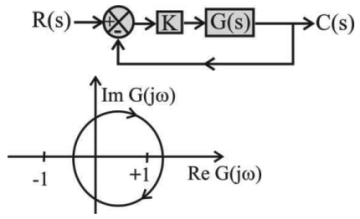
Consider the feedback system shown in the figure. The Nyquist plot of G(s) is also shown. Which one of the following conclusions is correct?
A. G(s) is an all-pass filter
B. G(s) is a strictly proper transfer function
C. G(s) is a stable and minimum-phase transfer function
D. The closed-loop system is unstable for sufficiently large and positive k
Select an option to see the answer and solution.
If the initial conditions for a system are inherently zero, what does it physically mean?
A. The system is at rest but stores energy
B. The system is working but does not store energy
C. The system is at rest or no energy is stored in any of its parts
D. The system is working with zero reference input
Select an option to see the answer and solution.
Which of the following statements with respect to the stability of a control system is true?
A. Only 1 and 3 are true
B. Only 1, 2 are true
C. Only 1, 2 and 3 are true
D. Only 4 is true
Select an option to see the answer and solution.
In the Bode diagram of H ( s ) = 1 + 10 s ,
Select an option to see the answer and solution.
A process is controlled by a PID controller. The sensor has high measurement noise. How can this effect be reduced?
A. By use of a bandwidth limited derivative term
B. By use of proportional and derivative terms in the forward path
C. By use of high proportional band
D. By use of low integral gain
Select an option to see the answer and solution.
In a servo-system, the device used for providing derivative feedback is known as:
A. Synchro
B. Servomotor
C. Potentiometer
D. Tachogenerator
Select an option to see the answer and solution.
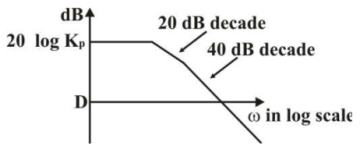
The type of system shown in the bode plot here is:
Select an option to see the answer and solution.
In a feedback system, feedback factor of 0.1 is used with forward gain of 10. The sensitivity of the system with respect to the feedback element is
Select an option to see the answer and solution.