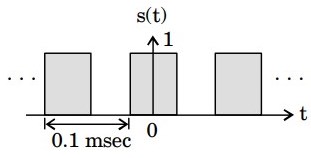
A continuous time function x(t) is periodic with period T. The function is sampled uniformly with a sampling period Ts. In which one of the following cases is the sampled signal periodic?
The phase response of a passband waveform at the receiver is given by φ(f)=−2πα(f−fc)−2αβfc,
where fc is the centre frequency, and α and β are positive constants. The actual signal propagation delay from the transmittance to receiver is
A continuous time LTI system is described by dt2d2y(t)+4dtdy(t)+3y(t)=2dtdx(t)+4x(t)
Assuming zero initial conditions, the response y(t) of the above system for the input x(t) = e-2tu(t) is given by
A system is described by the differential equation dt2d2y+5dtdy+6y(t)=x(t). Let x(t) be a rectangular pulse given by x\left( t \right) = \left\{ {\matrix{
{1,} & {0 < t < 2} \\
{0,} & {{\rm{otherwise}}} \\
} } \right.
Assuming that y(0) = 0 and dtdy=0 at t = 0, the Laplace transform of y(t) is
A signal containing only two frequency components (3 kHz and 6 kHz) is sampled at the rate of 8 kHz, and then passed through a low pass filter with a cut-off frequency of 8 kHz. The filter output
A sequence x(n) with the z-transform X(z) = z4 + z2 - 2z + 2 - 3z-4 is applied as an input to a linear, time-invariant system with the impulse response h(n) = 2δ(n - 3) where \delta \left( n \right) = \left\{ {\matrix{
{1,} & {n = 0} \\
{0,} & {{\rm{otherwise}}} \\
} } \right.
The output at n = 4 is
A real-valued signal x(t) limited to the frequency band ∣f∣≤2W is passed through a linear time invariant system whose frequency response is H\left( f \right) = \left\{ {\matrix{
{{e^{ - j4\pi f,}}} & {\left| f \right| \le {W \over 2}} \\
{0,} & {\left| f \right| > {W \over 2}} \\
} } \right.
The output of the system is
The signal x(t) = sin(14000πt), where t is in seconds is sampled at a rate of 9000 samples per second. The sampled signal is the input to an ideal lowpass filter with frequency response H(t) as follows: H\left( f \right) = \left\{ {\begin{array}{*{20}{c}}
{1,}&{\left| f \right| \leqslant 12kHz} \\
{0,}&{\left| f \right| > 12kHz}
\end{array}} \right.
What is the number of sinusoids in the output and their frequencies in kHz?
A signal 2cos(32πt)−cos(πt) is the input to an LTI system with the transfer function H(s)=es+e−s
If Ck denote the kth coefficient in the exponential Fourier series of the output signal, then C3 is equal to
A band-limited signal with a maximum frequency of 5 kHz is to be sampled. According to the sampling theorem, the sampling frequency which is not valid is