A system is defined by its impulse response h(n) = 2n u(n - 2). The system is
A. Stable and causal
B. Causal but not stable
C. Stable but not causal
D. Unstable and noncausal
Select an option to see the answer and solution.
A discrete time linear shift-invariant system has an impulse response h[n] with h[0] = 1, h[1] = -1, h[2] = 2, and zero otherwise. The system is given an input sequence x[n] with x[0] = x[2] = 1 and zero otherwise. The number of nonzero samples in the output sequence y[n], and the value of y[2] are, respectively
Select an option to see the answer and solution.
If the impulse response of a discrete-time system is h[n] = -5n u[- n - 1], then the system function H(z) is equal to
A. z − 5 − z
B. z − 5 z
C. z − 5 − z
D. z − 5 z
Select an option to see the answer and solution.
For an N-point FFT algorithm with N = 2m , which one of the following statements is TRUE?
A. It is not possible to construct a signal flow graph with both input and output in normal order
B. The number of butterflies in the mn state is m N
C. In-place computation requires storage of only 2N node data
D. Computation of a butterfly requires only one complex multiplication
Select an option to see the answer and solution.
A discrete-time signal x [n] = sin(π2 n), n being an integer, is
A. Periodic with period π
B. Periodic with period π2
C. Periodic with period 2 π
D. Not periodic
Select an option to see the answer and solution.
Which one of the following is an eigen function of the class of all continuous-time, linear, time-invariant systems (u(t) denotes the unit-step function)?
A. ejω0 t u(t)
B. cos(ω0 t)
C. ejω0 t
D. sin(ω0 t)
Select an option to see the answer and solution.
The Fourier Transform of a function x(t) is X(f). The Fourier transform of d t d x ( t )
A. d t d x ( t )
B. j 2 π f X ( f )
C. j f X ( f )
D. j f X ( f )
Select an option to see the answer and solution.
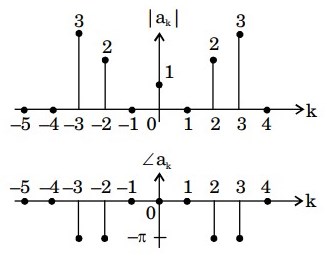
The magnitude and phase of the complex Fourier series coefficient a
k of a periodic signal x(t) are shown in the figure. Choose the correct statement from the four choices given. Notation: C is the set of complex number, R is the set of purely real numbers, and P is the set of purely imaginary numbers.
A. x ( t ) ∈ R
B. x ( t ) ∈ P
C. x ( t ) ∈ ( C − R )
D. The information given is not sufficient to draw any conclusion about x(t)
Select an option to see the answer and solution.
Let the signal i(t) = 0 outside the interval [T1 , T2 ], where T1 and T2 are finite. Furthermore, |f(t)| < ∞. The region of convergence (ROC) of the signal's bilateral Laplace transform F(s) is
A. A parallel strip containing the j Ω
B. A parallel strip not containing the j Ω
C. The entire s-plane
D. A half plane containing the j Ω
Select an option to see the answer and solution.
The z-transform F(z) of the function f(nT) = anT is
A. z − a T z
B. z + a T z
C. z − a − T z
D. z + a − T z
Select an option to see the answer and solution.
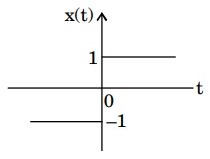
The function x(t) is shown in the figure. Even and odd parts of a unit-step function u(t) are respectively,
A. 2 1 , 2 1 x ( t )
B. − 2 1 , 2 1 x ( t )
C. 2 1 , − 2 1 x ( t )
D. − 2 1 , − 2 1 x ( t )
Select an option to see the answer and solution.
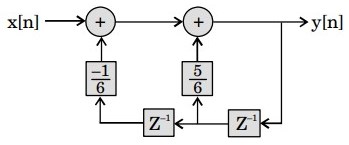
For the discrete-time system shown in the figure, the poles of the system transfer function are located at
A. 2, 3
B. 2 1 , 3
C. 2 1 , 3 1
D. 2 , 3 1
Select an option to see the answer and solution.
Let x [ n ] = ( − 9 1 ) n u ( n ) − ( − 3 1 ) n u ( − n − 1 ) .
A. Is ∣ z ∣ > 9 1
B. Is ∣ z ∣ < 3 1
C. Is 3 1 > ∣ z ∣ > 9 1
D. Does not exist
Select an option to see the answer and solution.
An LTI system having transfer function s 2 + 2 s + 1 s 2 + 1 s rad/s to obtain the final output {y(k)}. Which of the following is true?
A. y is zero for all sampling frequencies ωs
B. y is nonzero for all sampling frequencies ωs
C. y is nonzero for ωs > 2 but zero for ωs < 2
D. y is zero for ωs > 2 but nonzero for ωs < 2
Select an option to see the answer and solution.
Let x[n] = x[-n]. Let X(z) be the z-transform of x[n]. If 0.5 + j0.25 is a zero of X(z), which one of the following must also be a zero of X(z).
A. 0.5 - j0.25
B. ( 0.5 + j 0.25 ) 1
C. ( 0.5 − j 0.25 ) 1
D. 2 + j4
Select an option to see the answer and solution.
If G(f) represents the Fourier transform of a signal g(t) which is real and odd symmetric in time, then
A. G(f) is complex
B. G(f) is imaginary
C. G(f) is real
D. G(f) is real and non-negative
Select an option to see the answer and solution.
Consider the sequence
A. {-4 - j2.5, j2, 4 - j2.5}
B. {-j2.5, 1, j2.5}
C. {-j5, j2, 0}
D. {-4, 1, 4}
Select an option to see the answer and solution.
If the region of convergence of x1 [n] + x2 [n] is 3 1 < ∣ z ∣ < 3 2 , 1 [n] - x2 [n] includes
A. 3 1 < ∣ z ∣ < 3
B. 3 2 < ∣ z ∣ < 3
C. 2 3 < ∣ z ∣ < 3
D. 3 1 < ∣ z ∣ < 3 2
Select an option to see the answer and solution.
The Fourier series of an odd periodic function, contains only
A. Odd harmonics
B. Even harmonics
C. Cosine terms
D. Sine terms
Select an option to see the answer and solution.
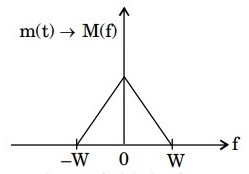
Increased pulse-width in the flat-top sampling, leads to
A. Attenuation of high frequencies in reproduction
B. Attenuation of low frequencies in reproduction
C. Greater aliasing errors in reproduction
D. No harmful effects in reproduction
Select an option to see the answer and solution.