The N-point DFT of a sequence x[n], 0 ≤ n ≤ N - 1 is given by X[K]=N1n=0∑N−1x[n]e−jN2πnK,0⩽K⩽N−1
Denote this relation as X = DFT(x). For N = 4, which one of the following sequences satisfies DFT (DFT (x)) = x.
A system is described by the following differential equation, where u(t) is the input to the system and y(t) is the output of the system. y(t) + 5y(t) = u(t)
When y(0) = 1 and u(t) is a unit step function, y(t) is
Consider the following statements for continuous-time linear time invariant (LTI) systems.
1. There is no bounded input bounded output (BIBO) stable system with a pole in the right half of the complex plane.
2. There is no causal and BIBO stable system with a pole in the right half of the complex plane.
Which one among the following is correct?
A system with transfer function H(z) has impulse response h(n) defined as h(2) = 1, h(3) = -1 and h(k) = 0 otherwise. Consider the following statements.
S1 : H(z) is a low-pass filter.
S2 : H(z) is an FIR filter.
Which of the following is correct?
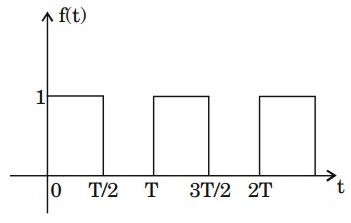
A first-order low-pass filter of time constant T is excited with different input signals (with zero initial conditions up to t = 0). Match the excitation signals X, V, Z with the corresponding time responses for t ≥ 0:
Match List-I with List-II and select the correct answer:
The transfer function of a discrete time LTI system is given by H(z)=1−43z−1+81z−22−43z−1
Consider the following statements:
S1 : The system is stable and causal for ROC:∣z∣>21
S2 : The system is stable but not causal for ROC:∣z∣<41
S3 : The system is neither stable nor causal for ROC:41<∣z∣<21
Which one of the following statements is valid?