Let x(t) be a periodic function with period T = 10. The Fourier series coefficients for this series are denoted by ak , that is x(t)=k=−∞∑∞akejkT2πt.
The same function x(t) can also be considered as a periodic function with period T' = 40. Let bk be the Fourier series coefficients when period is taken as T'. If k=−∞∑∞∣ak∣=16, then k=−∞∑∞∣bk∣ is equal to
A periodic signal x(t) of period T0 is given by x\left( t \right) = \left\{ {\matrix{
{1,} & {\left| t \right| < {T_1}} \\
{0,} & {{T_1} < \left| t \right| < {{{T_0}} \over 2}} \\
} } \right.
the dc component of x(t) is
Let P be linearity, Q be time-invariance, R be causality and S be stability. A discrete-time system has the input-output relationship, y\left( n \right) = \left\{ \matrix{
\matrix{
{x\left( n \right),} & {n \ge 1} \\
} \hfill \\
\matrix{
{0,} & {n = 0} \\
} \hfill \\
\matrix{
{x\left( {n + 1} \right),} & {n \le - 1} \\
} \hfill \\} \right.
where x(n) is the input and y(n) is the output.
The above system has the properties
Let x(t) be a wide sense stationary (WSS) random with power spectral density Sx(f). If Y(t) is the process defined as y(t) = x(2t - 1), the power spectral density SY(f) is
The Fourier series expansion of a real periodic signal with fundamental frequency f0 is given by gp(t)=n=−∞∑∞cnej2πf0t;
it is given that c3 = 3 + j5. Then c3 is
Consider the sequence x[n] = anu[n] + bnu[n], where u[n] denotes the unit-step sequence and 0 < |a| < |b| < 1. The region of convergence (ROC) of the z-transform of x[n] is
A 1 kHz sinusoidal signal is ideally sampled at 1500 samples/sec and the sampled signal is passed through an ideal low-pass filter with cutoff frequency 800 Hz. The output signal has the frequency
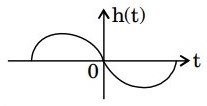
Consider a system whose input r and output y are related by the equation y(t)=−∞∫∞x(t−τ)h(2τ)dτ
Where h(t) is shown in the graph
Which of the following four properties are possessed by the system? BIBO: Bounded input gives a bounded output Causal: The system is causal. LP : The system is low pass. LTI: The system is linear and time-invariant.
The output y(t) of a linear time invariant system is related to its input x(t) by the following equation:
y(t) = 0.5x(t - td + T) + x(t - td) + 0.5x(t - td -T).
The filter transfer function H(ω) of such a system is given by
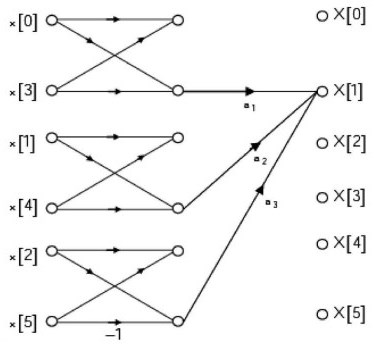
Consider a six-point decimation-in-time Fast Fourier Transform (FFT) algorithm, for which the signal-flow graph corresponding to X[I] is shown in the figure. Let W6=exp(−6j2π). In the figure, what should be the values of the coefficients a1, a2, a3 in terms of W6 so that X[I] is obtained correctly?