What is the value of y → 0 x → 0 lim x 2 + y 2 xy ?
A. 1
B. -1
C. 0
D. Limit does not exit
Select an option to see the answer and solution.
The Taylor series expansion of 3 sinx + 2 cosx is . . . . . . . .
A. 2 + 3x - x2 - 2 x 3
B. 2 - 3x + x2 - 2 x 3
C. 2 + 3x + x2 + 2 x 3
D. 2 - 3x - x2 + 2 x 3
Select an option to see the answer and solution.
Select an option to see the answer and solution.
The Taylor series expansion of x − π sin x x = π
A. 1 + 3 ! ( x − π ) 2 + ...
B. − 1 − 3 ! ( x − π ) 2 + ...
C. 1 − 3 ! ( x − π ) 2 + ...
D. − 1 + 3 ! ( x − π ) 2 + ...
Select an option to see the answer and solution.
If x = a (θ + sin θ) and y = a (1 - cos θ), then dx dy
A. sin( 2 θ )
B. cos( 2 θ )
C. tan( 2 θ )
D. cot( 2 θ )
Select an option to see the answer and solution.
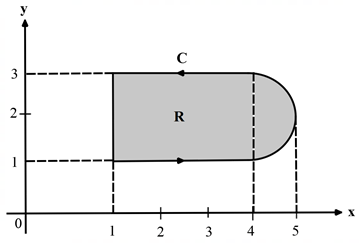
Consider the line integral
C ∫ ( xdy − ydx ) the integral being taken in a counterclockwise direction over the closed curve C that forms the boundary of the region R shown in the figure below. The region R is the area enclosed by the union of a 2 × 3 rectangle and a semi-circle of radius 1. The line integral evaluates to
Select an option to see the answer and solution.
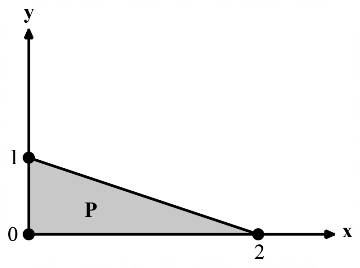
Consider the shaded triangular region P shown in the figure. What is If
P ∬ xydxdy ? Select an option to see the answer and solution.
Let ϕ
Select an option to see the answer and solution.
The magnitude of the directional derivative of the function f(x, y) = x2 + 3y2 in a direction normal to the circle x2 + y2 = 2, at the point (1, 1), is
Select an option to see the answer and solution.
If S = 1 ∫ ∞ x − 3 dx,
Select an option to see the answer and solution.
The function f(x) = 2x3 - 3x2 - 36x + 2 has its maxima at
A. x = -2 only
B. x = 0 only
C. x = 3 only
D. both x = -2 and x = 3
Select an option to see the answer and solution.
The minimum value of the function f ( x ) = ( 3 x 3 ) − x
Select an option to see the answer and solution.
The function f(x) = 2x - x2 + 3 has
A. a maxima at x = 1 and a minima at x = 5
B. a maxima at x = 1 and a minima at x = -5
C. only a maxima at x = 1
D. only a minima at x = 1
Select an option to see the answer and solution.
The function y = |2 - 3x|
A. is continuous ∀ x ∈ R ∀ x ∈ R
B. is continuous ∀ x ∈ R ∀ x ∈ R 2 3
C. is continuous ∀ x ∈ R ∀ x ∈ R 3 2
D. is continuous ∀ x ∈ R ∀ x ∈ R
Select an option to see the answer and solution.
Which of the following is correct?
A. x → 0 lim ( sin 2 x sin 4 x ) = 1 and x → 0 lim ( x tan x ) = 1
B. x → 0 lim ( sin 2 x sin 4 x ) = ∞ and x → 0 lim ( x tan x ) = 1
C. x → 0 lim ( sin 2 x sin 4 x ) = 2 and x → 0 lim ( x tan x ) = ∞
D. x → 0 lim ( sin 2 x sin 4 x ) = 2 and x → 0 lim ( x tan x ) = 1
Select an option to see the answer and solution.
The double integral 0 ∫ a 0 ∫ y f ( x, y ) dx dy
A. 0 ∫ x 0 ∫ y f ( x, y ) dx dy
B. 0 ∫ a x ∫ y f ( x, y ) dx dy
C. 0 ∫ a x ∫ a f ( x, y ) dy dx
D. 0 ∫ a 0 ∫ a f ( x, y ) dx dy
Select an option to see the answer and solution.
The values of x for which the function f ( x ) = x 2 + 3 x − 4 x 2 − 3 x − 4
A. 4 and -1
B. 4 and 1
C. -4 and 1
D. -4 and -1
Select an option to see the answer and solution.
The expression V = ∫ 0 H π R 2 ( 1 − H h ) 2 dh
A. ∫ 0 R π R 2 ( 1 − H h ) 2 dr
B. ∫ 0 R π R 2 ( 1 − H h ) 2 dh
C. ∫ 0 H 2 π rH ( 1 − R r ) 2 dh
D. 4 ∫ 0 R π rH ( 1 − R r ) 2 dr
Select an option to see the answer and solution.
Consider the function f(x) = |x| in the interval -1 < x ≤ 1. At the point x = 0, f(x) is
A. continuous and differentiable
B. non continuous and differentiable
C. continuous and non-differentiable
D. neither continuous nor differentiable
Select an option to see the answer and solution.
For a scalar function f(x, y, z) = x2 + 3y2 + 2z2 , the gradient at the point P(1, 2, -1) is
Select an option to see the answer and solution.