In a simple bending of beams, the stress in the beam varies
A. Linearly
B. Parabolically
C. Hyperbolically
D. Elliptically
Select an option to see the answer and solution.
The moment of resistance of a balanced reinforced concrete beam is based on the stresses in
A. Steel only
B. Concrete only
C. Steel and concrete both
D. None of these
Select an option to see the answer and solution.
The bending equation is
A. I M = y σ = R E
B. J T = R τ = I C θ
C. R M = J T = I C θ
D. I T = J τ = C θ R
Select an option to see the answer and solution.
In a watch, the spring is used to store strain energy. This energy is released
A. To stop the watch
B. To run the watch
C. To change the time
D. All of these
Select an option to see the answer and solution.
In a beam where shear force changes sign, the bending moment will be
A. Zero
B. Minimum
C. Maximum
D. Infinity
Select an option to see the answer and solution.
A closely-coiled helical spring is cut into two halves. The stiffness of the resulting spring will be
A. Same
B. Double
C. Half
D. One-fourth
Select an option to see the answer and solution.
The shear force diagram for a simply supported beam carrying a uniformly distributed load of w per unit length, consists of
A. One right angled triangle
B. Two right angled triangles
C. One equilateral triangle
D. Two equilateral triangles
Select an option to see the answer and solution.
Efficiency of a riveted joint is the ratio of its strength (max. load it can resist without failure) to the strength of the unpunched plate in
A. Tension
B. Compression
C. Bearing
D. Any one of the above
Select an option to see the answer and solution.
In the tensile test, the phenomenon of slow extension of the material, i. e. stress increasing with the time at a constant load is called
A. Creeping
B. Yielding
C. Breaking
D. Plasticity
Select an option to see the answer and solution.
The direct stress induced in a long column is __________ as compared to bending stress.
A. Same
B. More
C. Less
D. Negligible
Select an option to see the answer and solution.
The slenderness ratio is the ratio of
A. Area of column to least radius of gyration
B. Length of column to least radius of gyration
C. Least radius of gyration to area of column
D. Least radius of gyration to length of column
Select an option to see the answer and solution.
The ratio of bulk modulus to Young's modulus for a Poisson's ratio of 0.25 will be
Select an option to see the answer and solution.
The strain energy stored in a hollow circular shaft of outer diameter (D) and inner diameter (d) subjected to shear stress is
A. 2 C τ 2 ( D D 2 − d 2 ) × Volume of shaft
B. 2 C τ 2 ( D D 2 + d 2 ) × Volume of shaft
C. 4 C τ 2 ( D D 2 − d 2 ) × Volume of shaft
D. 4 C τ 2 ( D D 2 + d 2 ) × Volume of shaft
Select an option to see the answer and solution.
Shear stress induced in a shaft subjected to tension will be
A. Maximum at periphery and zero at center
B. Maximum at center
C. Uniform throughout
D. None of the above
Select an option to see the answer and solution.
The Young's modulus of a material is 125 GPa and Poisson’s ratio is 0.25. The modulus of rigidity of me material is
A. 30 GPa
B. 50 GPa
C. 80 GPa
D. 100 GPa
Select an option to see the answer and solution.
When a body is subjected to a direct tensile stress (σ θ
A. σ sin 2 θ
B. σ cos 2 θ
C. 2 σ sin 2 θ
D. 2 σ cos 2 θ
Select an option to see the answer and solution.
When a body is subjected to a direct tensile stress (σ θ
A. σ cos θ
B. σ cos 2 θ
C. σ sin θ
D. σ sin 2 θ
Select an option to see the answer and solution.
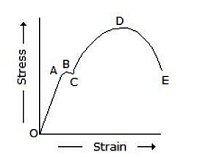
In the below figure, the point C represents
A. Elastic limit
B. Upper yield point
C. Lower yield point
D. Breaking point
Select an option to see the answer and solution.
The maximum deflection of a fixed beam carrying a central point load lies at
A. Fixed ends
B. Center of beam
C. 3 l
D. None of these
Select an option to see the answer and solution.
When a bar of length 'l
A. 2 E w l
B. 2 E w l 2
C. 2 E w l 3
D. 2 E w l 4
Select an option to see the answer and solution.