Assertion (A) Under stressful situation, a person is unable to listen to and understand the message correctly.Reason (R) During stressful situations, the psychological frame of mind changes and the message gets distorted due to the beliefs, experience, goals and values held by the receiver of the message.
A. Both (A) and (R) are correct and (R) is the correct explanation of (A)
B. Both (A) and (R) are correct, but (R) is not the correct explanation of (A)
C. (A) is correct, whereas (R) is incorrect
D. (R) is correct, whereas (A) is incorrect
Select an option to see the answer and solution.
Match the following.
List-I (Theories of Motivation) List-II (Developers)
a. Cognitive Evaluation theory
1. R. De. Charms
b. Goal Setting theory
2. Edwin Locks
c. Reinforcement theory
3. Skinner
d. Equity theory
4. J. S. Adams
A. a-1, b-2, c-3, d-4
B. a-4, b-3, c-2, d-1
C. a-1, b-4, c-2, d-3
D. a-1, b-3, c-4, d-2
Select an option to see the answer and solution.
Match the following:
List-I (Thinkers) List-II (Books)
a. Argyros, O. C.
1. An introduction to motivation
b. Atkinson J. W.
2. Reinforcement Theory
c. Dubin, Robert
3. The world of work
d. Skinner, B. F.
4. Personal vs Organisational Goals
A. a-1, b-2, c-3, d-4
B. a-4, b-1, c-3, d-2
C. a-3, b-4, c-2, d-1
D. a-3, b-1, c-4, d-2
Select an option to see the answer and solution.
Match the below mentioned aspects with their main behavioural disciplines.
List-I (Aspects) List-II (Behavioural discipline)
a. Leadership and stress management
1. Psychology
b. Group conflict management
2. Anthropology
c. Cross-cultural analysis
3. Sociology and Psychology
d. Power
4. Political Science
A. a-4, b-1, c-2, d-3
B. a-2, b-3, c-1, d-4
C. a-1, b-4, c-2, d-3
D. a-4, b-2, c-3, d-1
Select an option to see the answer and solution.
According to J. Kelly, determinants of personality are
A. heredity
B. physique
C. childhood experiences
D. All of these
Select an option to see the answer and solution.
Assertion (A) Organisation Development (OD) is a planned effort and therefore requires a great deal of thinking and planning on the part of the OD expert. Knowledge and skills of the applied behavioural sciences are used in OD.Reason (R) OD cannot succeed unless the people at the top are committed to what is being done. By definition, OD has a begin form the top.
A. (A) is correct, (R) is not correct
B. (R) is correct, (A) is not correct
C. Both (A) and (R) are correct, (R) explains (A)
D. Both (A) and (R) are correct, (R) does not explain (A)
Select an option to see the answer and solution.
Financial incentives include
A. Insurance
B. Additional Bonus
C. Participation in profit
D. All of the above
Select an option to see the answer and solution.
Acoording to situational leadership approach, the style that denotes a high-task and a low relationship style is
A. selling style
B. delegating style
C. participating style
D. telling style
Select an option to see the answer and solution.
Of the four building block skills, which one is frequently considered to be the largest behavior management challenge?
A. The ability to inspire employees
B. The ability to analyze situations correctly
C. Personal flexibility and adaptability
D. Outstanding perceptual skills
Select an option to see the answer and solution.
Match the following:
List-I (Classical School) List-II (Philosopher)
a. Scientific management approach
1. Taylor
b. Administrative theory
2. Henry Fayol
c. Human relations
3. Marshal
d. Neo-classical Behavioural Science approach
4. Elton Mayo
5. Mary Parker Follet
A. a-4, b-1, c-3, d-2
B. a-3, b-1, c-4, d-2
C. a-1, b-2, c-3, d-4
D. a-1, b-2, c-4, d-5
Select an option to see the answer and solution.
Which of these best describe the degree to which group members came together as one unit to reach a common goal?
A. Group cohesion
B. Group focus
C. Group dynamics
D. Group synergy
Select an option to see the answer and solution.
The manifestations of OB relate to
A. organisational structure, management processes and technology
B. biological-physiological,structure, and personality
C. organisationl dynamics, conflict, change and adaptation
D. None of the above
Select an option to see the answer and solution.
Match the following.
List-I List-II
a. 1, 9
1. Impoverished Management
b. 1, 1
2. Team Management
c. 9, 1
3. Country Club Management
d. 9, 9
4. Task Management
A. a-4, b-3, c-1, d-2
B. a-1, b-3, c-4, d-2
C. a-3, b-1, c-4, d-2
D. a-3, b-1, c-2, d-4
Select an option to see the answer and solution.
Which of the following asserts that people tend to affiliate with one another because of spatial or geographical closeness?
A. Balance theory
B. Exchange theory
C. Propinquity theory
D. None of these
Select an option to see the answer and solution.
When an industrial organization installs specialized equipment to monitor potentially hazardous emissions due to environmentalist pressure, they are in essence experiencing change that is . . . . . . . .
A. unplanned
B. temporary
C. planned
D. guided by upper-level management
Select an option to see the answer and solution.
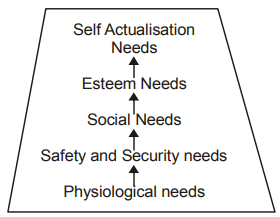
Given
The above Pyramid form is a representation of
A. Maslow's Hierarchy of Needs
B. Alderfer's ERG theory
C. Murray's Manifest need theory
D. Adam's Equity theory
Select an option to see the answer and solution.
Human relations is worth studying because it contributes towards
A. "people skills" building
B. mass conformity
C. weakening of unions
D. None of these
Select an option to see the answer and solution.
Which of the following is not a critical are of Six-Box Model of Organisational Diagnosis?
A. Structure
B. Mechanisms
C. Relationships
D. Learning
Select an option to see the answer and solution.
The characteristics of organisational development is/are
A. Participation of a change agent
B. Diagnostic efficiency
C. Adjustment capacity
D. All of the above
Select an option to see the answer and solution.
Arrange the four stages of group formation into the correct sequence of their development.
A. 4, 3, 1, 2
B. 2, 4, 1, 3
C. 2, 1, 4, 3
D. 1, 2, 3, 4
Select an option to see the answer and solution.