Match the stages of Process of Organisational Change (List-I) with their possible descriptions (List-II) given below.
| List-I |
List-II |
| a. Diagnosis |
1. The stage for framing a proposal in relation to the problems or issues identified |
| b. Stabilisation |
2. The attempt to search for the main cause underlying the symptoms encountered |
| c. Motivation |
3. The stage where people are involved in detailed consideration of the proposed change |
| d. Action Proposal |
4. The stage of internalising the change and making it a part of the organisation's normal life |
Select an option to see the answer and solution.
People dislike work and seek to avoid it at all costs' applies to which organisational behaviour theory?
Select an option to see the answer and solution.
Perception is
Select an option to see the answer and solution.
Fayol attempted to develop
Select an option to see the answer and solution.
Given:
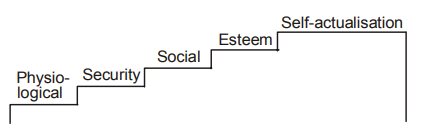
The figure represents . . . . . . . . Theory of Motivation.
Select an option to see the answer and solution.
Match the following:
| List-I (Organisational Behaviour Theory) |
List-II (Developers) |
| a. Comparative theory |
1. Arnest Del |
| b. System theory |
2. Bemard |
| c. Decision theory |
3. Herbert Siamon |
| d. Fusion process theory |
4. Backkey and Kricks |
Select an option to see the answer and solution.
OD Cube (Sehmuck and Miles), Consulcube (Blake and Mouton) and Four Quadrants (French and Bell) are the examples of
Select an option to see the answer and solution.
Which of the following is/are importance of Motivation?
Select an option to see the answer and solution.
Match the following:
| List-I (Type of Stresses) |
List-II (Examples) |
| a. Intra-Personal |
1. Nature of job |
| b. Job Related |
2. Group processes |
| c. Inter-Personal |
3. Role conflict |
| d. Inter-Organisational |
4. Noise |
Select an option to see the answer and solution.
In Vroom's Expectancy Theory, Valence means
Select an option to see the answer and solution.
A motive is defined as
Select an option to see the answer and solution.
Match the following:
| List-I (Thinkers) |
List-II (Books) |
| a. Mintzberg |
1. Organisation theory |
| b. Janckson and Margan |
2. General and Industrial Administration |
| c. Graicunas, V. A. |
3. Relationship and organisation |
| d. Fayol |
4. The structuring of organisations |
Select an option to see the answer and solution.
Maddi's Model is a
Select an option to see the answer and solution.
Organisation theory is mainly concerned with
Select an option to see the answer and solution.
Which is hygiene factor of Herzberg's two Factors Theory?
Select an option to see the answer and solution.
The reasons of conflict within the individuals are
Select an option to see the answer and solution.
Who has asserted that management skill is a must, while technical competence is highly desirable but not essential?
Select an option to see the answer and solution.
Who of the following is related to path-goal theory of leadership?
Select an option to see the answer and solution.
When one group's performance depends on another group's performance, it may result into inter-group conflict. Such dependence is described as
Select an option to see the answer and solution.
Match the following.
| List-I (Theory of Leadership) |
List-II (Propagator) |
| a. Contingency Theory |
1. Martin Evan and Robert House |
| b. Path-goal Theory |
2. Fred Fiedler |
| c. Situational Leadership Theory |
3. Paul Hersey and Ken Blanchard |
| d. Greatman Theory |
4. Gordon Alport |
Select an option to see the answer and solution.
