A microphone is connected between the base and the ground of a BJT. A 1 kΩ resistance is connected between the collector VCC. If Is = 6 × 10-16 A and the peak value of the microphone signal is 20 mV, what is the peak value of the output signal?
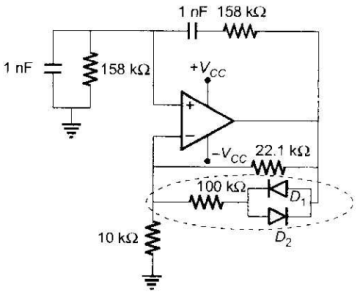
Consider the oscillator circuit shown in the figure. The function of the network (shown in dotted lines) consisting of the 100 kΩ resistor in series with the two diodes connected back-to-back is to:
A multistage amplifier employs five stages each of which has a power gain of 30? The total gain of the amplifier in dB is . . . . . . .
(log10 30 = 1.477)
Consider the following statements:
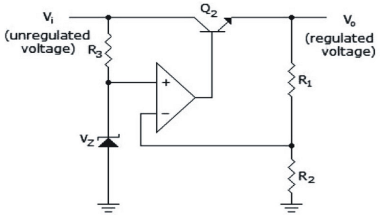
Monolithic regulators can be used to
1. Realize a constant voltage regulator.
2. Realize a constant current regulator.
3. Introduce flexibility in setting output voltage level.
Of these statements
A monolithic metal oxide semiconductor (MOS) non-polarized capacitor which is a parallel plate capacitor with SiO2 as dielectric. A surface thin film of metal (aluminum) is the top plate. The bottom plate consists of the heavily doped n* region that is formed during emitter diffusion. What is the typical value of
capacitance for an oxide thickness of 500 Å of this MOS capacitor?
Take the permittivity of dielectric (εr) as 4.
The value of hFE (the hybrid parameters) of a Common-Emitter (CE) connection of a Bipolar Junction Transistor (BJT) is given as 250. What is the value of αdc (ratio of collector current to emitter current), for this BJT?
Consider the following statements regarding an op-amp:
1. All types of negative feedback reduce nonlinear distortion.
2. All types of negative feedback reduce the output offset voltage.
3. Non-inverting (current and voltage) feedback increases the input impedance.
4. Inverting (current and voltage) feedback decreases input impedance.
Which of the above statements is/are correct?
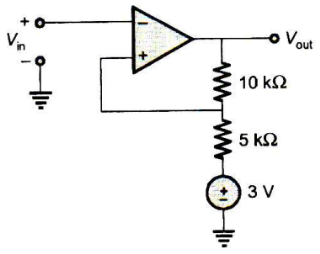
For the operational amplifier circuit shown, the output saturation voltages are ±15 V. The upper and lower threshold voltages for the circuit are, respectively,